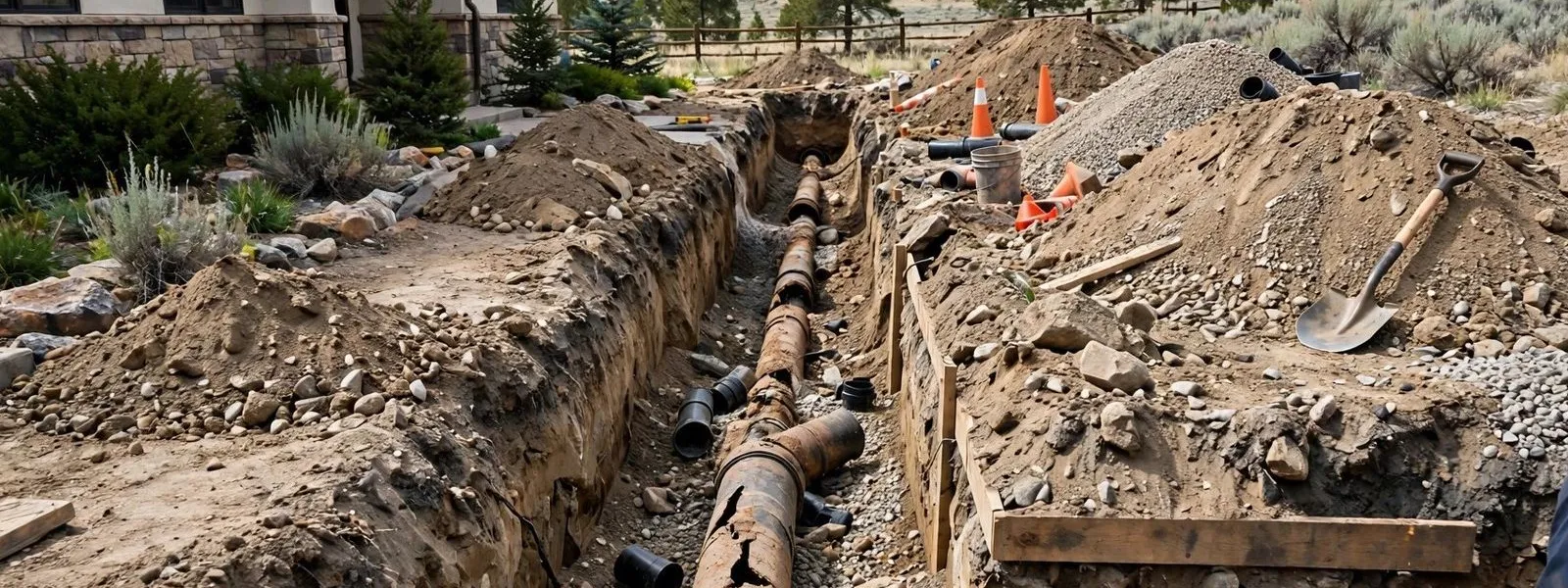
When sewage backs up in a Newark, DE home, call the City's Water and Wastewater office first and ask for a check of the main under the street. If the main is clear, the stoppage is on the lateral (the pipe running from the house to the main) or the house line, and you hire a licensed plumber to find which section.
Sec. 25-2 decides who pays for each stretch. That order saves you from paying to dig up something the City already owns.
While you wait, stop running water, keep everyone away from floor drains and move belongings off a wet basement floor. We dispatch 24/7, so an after-hours call is possible if the City confirms the main is clear.
The rest of this guide explains how the code divides the work, how a clogged line gets diagnosed, and when a clog turns into sewer line repair in Newark, DE rather than simple clearing.
Who owns which part of the pipe
Newark's sewer code, Sec. 25-2, separates owner and City duties by location and by cause. It is more detailed than the common shorthand that the homeowner owns everything from the house to the main, so the specifics are worth reading.
| Situation | Who handles it under Sec. 25-2 | Why it matters |
|---|---|---|
| Stoppage caused by grease, soap or other material from the house | Owner | The lateral stoppage is yours to clear |
| Roots in the lateral when there is no cleanout near the property line | Owner | Without that access point, the clearing is yours |
| Cracked or broken pipe from the property line to the house | Owner | Repair is on your side of the line |
| Roots from the property line out to the main, with a cleanout near the line | City | Having the cleanout shifts that stretch to the City |
| Failed lateral from the property line out to the main | City | Fixing or replacing that stretch is the City's job |
If roots can only come out of the right-of-way stretch by digging, the code says the City handles the excavation, root removal and pipe repair in the right-of-way only. An owner can also ask the City to manage roots entering from the right-of-way by installing a cleanout on the property line.
Read that as a map, not a verdict. A plumber with a camera can show which section holds the problem, and the City confirms its side. Ask both before you accept a bill for the street section.
Signs the clog is in the sewer line
A fixture clog stays at one drain. A sewer line clog shows up across the house.
Several fixtures at once
A tub gurgles when the washing machine drains, or a toilet bubbles when you run the sink.
Backup in the lowest drain
Water or sewage appears in a basement floor drain or shower first because it is the lowest opening.
Slow flushing after the plunger
The toilet clears but refills slowly, then clogs again within a day.
Repeat clogs after cleaning
The line opens, then fails again in a few weeks, which often points to roots or a damaged section.
Sewage odor outside
A smell near the cleanout or a soggy patch in the yard can mean the line is broken.
What the City checks, and what the plumber does
The City's guide says it will send a crew to inspect the main under the street. If the main is clear, you are on your own to hire a plumber. Expect the plumber to start by finding the cleanout, then clearing with a cable machine or a water jet, then running a camera to see why the line clogged.
The camera step matters. A one-time grease clog needs cleaning, while a collapsed section, an offset joint or a root intrusion needs repair. A plumber who clears the line without looking leaves you guessing whether it will fail again, so ask for a sewer camera inspection when the line has clogged more than once.
- Stop adding waterSkip showers, laundry and the dishwasher. Every flush adds to the backup.
- Phone the City's water and wastewater officeAsk for a check of the main. They are available 24/7 according to the City.
- Call a licensed plumber if the main is clearShare what you saw, which fixtures were slow and whether this has happened before.
- Clear and camera the lateralThe plumber opens the line, then inspects it so the cause is known.
- Decide on repair or liningA damaged section may need a spot repair or replacement, covered by Sec. 25-2 if it is on the City's side of the property line.
Planning this repair?
Call to book a same-day appointment when one is available. You get a clear price before work starts.
Repair or clearing: how the options compare
Clearing removes the blockage. Repair fixes the pipe that let it form. The right option depends on what the camera shows, and cost depends on depth, length, access and whether the work crosses paved areas or trees, so there is no honest flat answer. We cannot name a price here, and the plumber who looks at your line will quote a clear price before work starts.
For a short damaged section, a spot repair or excavation may be enough. For longer runs, some plumbers offer trenchless methods that avoid trenching across a yard, though they suit only certain pipe conditions. If the line has bellied or sagged so it holds water, no lining will fix it, because the dip stays.
What Newark property owners should know
That permit point is easy to miss. Before a plumber digs up your yard, ask who is pulling the permit. Our Bear and Elkton pages cover areas outside the City, where permits and sewer rules come from different offices.
New Castle County also runs a home repair program that lists sewer lines among eligible repairs for qualified homeowners. The county page does not say whether homes inside Newark city limits qualify, so ask the County directly before you count on it.
Keeping the line clear afterward
Most repeat clogs come from habits and trees. Keep grease, rags, wipes, diapers and sanitary products out of the line. If roots keep returning, a property-line cleanout lets the City manage roots in its stretch and gives a plumber a clean access point. Regular sewer line cleaning helps when roots are the cause, though no official source sets a fixed interval.
Frequently asked questions
Begin with the City, because a crew checks the main under the street. If the main is clear, the clog is in the lateral, and Sec. 25-2 decides who handles each section. Grease and soap stoppages, and roots with no cleanout, fall to the owner.
Usually not, by the City's own account. Because many policies exclude sewer backup, ask your insurer about a rider. Take photos before you clean anything up.
You can run a small cable through an accessible cleanout, but sewer lines are deeper, longer and easier to damage than a sink trap. A cable can also push a blockage further without removing it. If the line backs up again, call a licensed plumber for a cable and camera.
Yes. A camera shows roots, cracks, offset joints and low spots. That image also helps decide whether the City's section is involved.
Use the state's online license lookup at delpros.delaware.gov, run by the Division of Professional Regulation. State law reserves plumbing work for licensed plumbers, and Newark also licenses contractors who work in the city.
Need a plumber instead of an answer?
Call (410) 378-7601