A drain that will not empty is an emergency the moment water starts climbing toward the rim. Newark 24/7 Plumbing answers calls around the clock and sends a licensed plumber for emergency drain cleaning in Newark, DE. While you wait, stop running water in every fixture, keep the plug out, and do not pour anything from a bottle into the drain.
Most stoppages in a home sit in one of two places. A fixture clog is in the trap or the short branch pipe behind one sink, tub or shower. A main line clog sits farther down, where several drains join, and it shows up as trouble in more than one place at once.
This page covers both, along with the cable (or "snake") work that clears them. If the same drain keeps stopping up after a cleaning, that points to buildup on the pipe wall, and hydro jetting is the better tool for it.
Water coming up or draining slowly right now
Standing water changes what you should do first. A few minutes of the right steps keep a nuisance from turning into a wet floor and a longer repair.
- Stop using every sink, tub, shower, dishwasher and washing machine until the drain is clear.
- Find out whether it is one drain or several. Run a little water in the lowest fixture in the house and watch the others.
- If a floor drain or basement fixture is bubbling or gurgling, treat that as a possible main line problem and keep people and pets out of the area.
- Put towels or a wet-dry vacuum to work on spills, and keep electrical cords and appliances out of standing water.
- Leave chemical openers on the shelf. They sit in the pipe and can burn skin or eyes if the trap has to be opened.
- Clear the area under the sink so the plumber can reach the trap.
Night calls are routine for this problem, because a clog often gets worse after the dishwasher cycle or a houseful of showers. After-hours and weekend visits follow the same steps as daytime ones, and same-day appointments are available when the schedule allows.
Telling a fixture clog from a main line clog
The location of the blockage decides the tool, the time on site, and sometimes whether the City needs a call. The table below matches common symptoms to the likely spot.
| What you notice | Likely location | What usually clears it |
|---|---|---|
| One sink or tub drains slowly, others fine | Trap or branch pipe at that fixture | Hand auger or small cable |
| Tub and bathroom sink both slow | Shared bathroom branch line | Cable through the branch cleanout or vent access |
| Basement floor drain gurgles when upstairs fixtures run | Main drain or house lateral | Larger cable, then a camera if it returns |
| Toilets, tubs and floor drain all back up together | Main line or lateral | Main line cable, possibly jetting |
| Sewage smell and wet floor near a drain | Main line or the City's sewer | Stop water use, then see the sewer cleaning page |
If your symptoms land in the last two rows, the problem is probably past the point a fixture cable can reach. Our page on cleaning the sewer lateral and main explains what happens when the blockage is out in the lateral or the street main.
Kitchen sink drain clogs
The kitchen drain takes more punishment than any other in the house. Cooking fat goes in warm and liquid, then cools on the pipe wall and catches coffee grounds, rice, eggshell and food scraps. After a few months the opening has narrowed to a fraction of its original size, and a sink that "drains a little slow" becomes a sink that holds water all day.
A kitchen clog usually builds in one of three spots: the P-trap under the sink, the horizontal arm that runs into the wall, or the vertical stack that carries the kitchen branch down toward the main. The plumber starts at the trap, because it is the cheapest place to look and often holds the whole problem. If the trap is clean, a cable goes through the wall access and works along the arm.
A disposal can hide a jam of its own, and the dishwasher drain hose joins the line just before the trap. A blockage there sends dirty water back into the dishwasher, so mention standing water in the dishwasher on the call.
Grease is the repeat offender. The City of Newark's Sewer Care Guide asks residents to keep fats, oils and grease out of drains, and that advice protects your own kitchen line first. Wipe pans with a paper towel before washing, pour cooled grease into a can for the trash, and run a strainer in the sink.
How drain snaking and cabling works
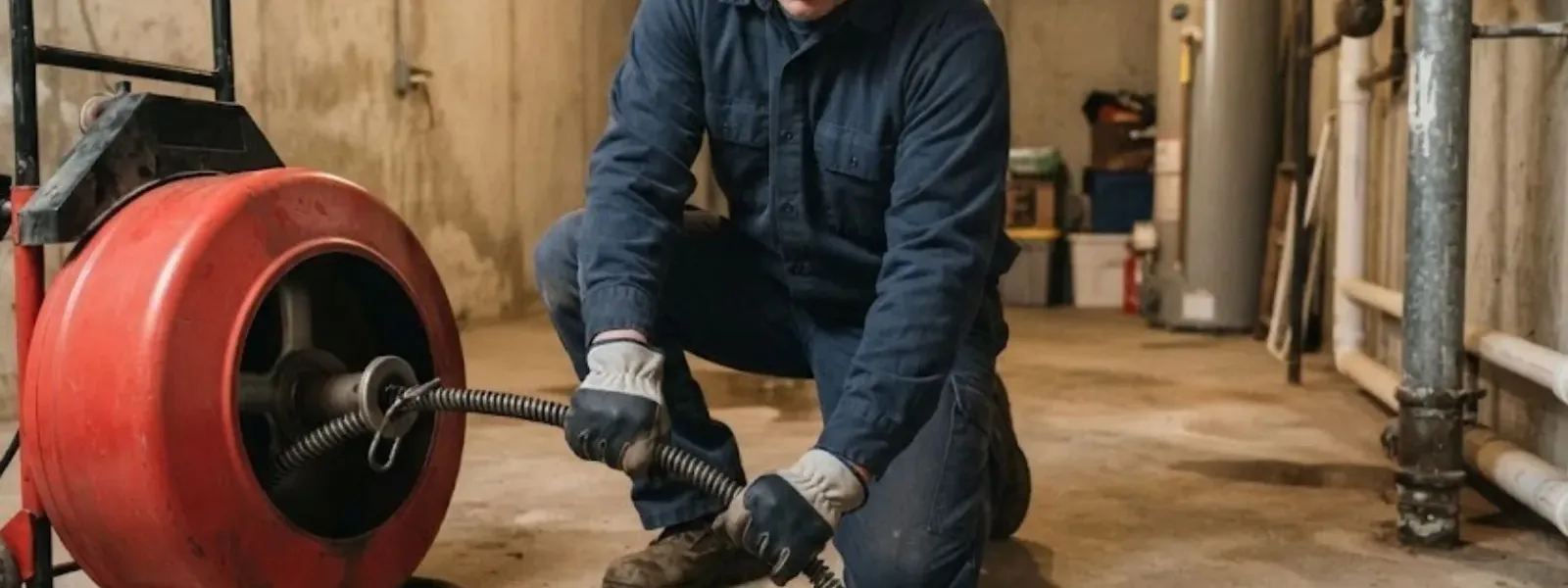
Snaking and cabling are two names for the same job. A flexible steel cable with a cutting or hooking head is fed into the pipe, and a motor spins it so the head bores through or grabs the blockage. The plumber matches the cable size to the pipe: a hand-cranked auger for a sink trap, a motor-driven drum machine for a branch line, and a longer, heavier cable for a main drain.
- Find the access pointThe plumber pulls the trap, opens a cleanout, or lifts a floor drain cover so the cable enters as close to the clog as possible.
- Feed the cable until it stopsThe length of cable that goes in tells the plumber roughly how far down the blockage sits.
- Break up or hook the clogThe spinning head cuts through soft buildup or snags a mass of hair or paper so it can be pulled back out.
- Pull the cable and flushWater is run to confirm full flow, and the cable is washed on the way out so the mess stays in the sink or pan.
- Test the whole branchOther fixtures on the same line get a drain test, because a clog that comes back in a week often had a second blockage behind it.
Cabling opens a path. It does not scrub the whole pipe wall, so a narrow channel can reopen through grease and close again within weeks. When that pattern shows up, the plumber may recommend a camera look or a high-pressure jetting visit rather than another cable run.
Water where it should not be?
Close the nearest shutoff, then call. We answer around the clock.
Why chemical drain openers make things worse
Store-bought openers are tempting at midnight, but they rarely clear a solid blockage and they leave a hazard behind. The EPA's advice is to avoid chemical drain openers for a clogged drain and to use boiling water or a drain snake instead, as stated in its guidance on caring for household plumbing and septic systems. That guidance was written with septic homes in mind, but the plumbing logic applies to any house.
There is a practical cost too. Caustic liquid left standing in the trap makes it unsafe to open without gloves and eye protection, and repeated doses can damage older pipe and fittings. Tell the plumber what you used and when.
What Newark's Sewer Care Guide means for your drain
The City of Newark maintains more than 100 miles of public sanitary sewer main. Its Sewer Care Guide puts the pipe from your house to the main (the lateral) in the owner's hands for clearing, with the City handling blockages in its own main.
For a drain problem, that means the first question is whether the clog is inside your walls, in your lateral, or in the street. A single slow fixture is almost always inside. A house-wide backup with a clean-looking trap could be either of the other two, and the plumber can usually tell by where the cable stops and how the water behaves.
The City's adopted development plan describes many neighborhoods around Hillside Park pond, including the Oaklands and Nottingham Green drainage area, as built in the 1950s and 1960s.
A house that old has had decades of kitchen and laundry use through the same branch lines, so a camera look is worth asking about if you keep having trouble. Our Brookside plumbing page covers nearby addresses outside the city line, where the sewer rules may come from New Castle County instead of the City.
A drain line that leaks
A leaking drain shows up as a damp cabinet floor, a ceiling stain below a bathroom, or a musty smell near a slab. The cause can be a loose slip nut, a cracked fitting, or a failed joint behind a wall. Run one fixture at a time and watch which one makes the stain grow. A hidden leak inside a wall may need a camera or a pressure test before anything is opened.
What affects the price of drain cleaning
Standard homeowners policies typically cover sudden and accidental damage but not wear, gradual leaks or flood, and the City of Newark's own sewer guide notes that many policies exclude sewage backup. Check your own policy before you assume a drain-related loss is covered. Call for your real number: the plumber will give you a clear price before work starts.
Questions about drain cleaning in Newark, DE
Yes. Calls are answered 24/7, and a licensed plumber can be sent to a house with water rising in a tub, a basement floor drain backing up, or a kitchen sink that will not empty. Same-day appointments are available when the schedule allows, including Saturdays and Sundays. Tell the dispatcher which fixtures are affected and whether water is reaching the floor.
It is better not to. The EPA recommends avoiding chemical drain openers and using boiling water or a drain snake instead. Caustic liquid that fails to clear the clog stays in the pipe and makes it harder and less safe for the plumber to open a trap or cleanout.
A single slow fixture is inside your house. When every drain is slow or a basement floor drain backs up, the blockage may be in your lateral or in the City main. Under the Sewer Care Guide, the City clears its own main and you arrange for the lateral, so a plumber's cable test helps sort out which one you have.
A cable opens a channel through the buildup but does not strip the pipe wall clean. Grease, soap scum and food film keep narrowing the line, and the channel closes again. A camera look and a jetting visit are the next step if the clog returns within weeks.
A properly sized cable is gentle on sound pipe, but it can catch on a cracked, rusted or offset section and make a weak spot worse. Cast iron and clay drains from older houses deserve more caution. The plumber should stop and recommend a camera inspection if the cable behaves oddly.
The City of Newark's Sewer Care Guide lists fats, oils, grease, rags, disposable diapers and sanitary napkins, along with paper other than toilet paper. The EPA also lists non-flushable wipes. Put all of it in the trash.
Need a plumber instead of an answer?
Call (410) 378-7601