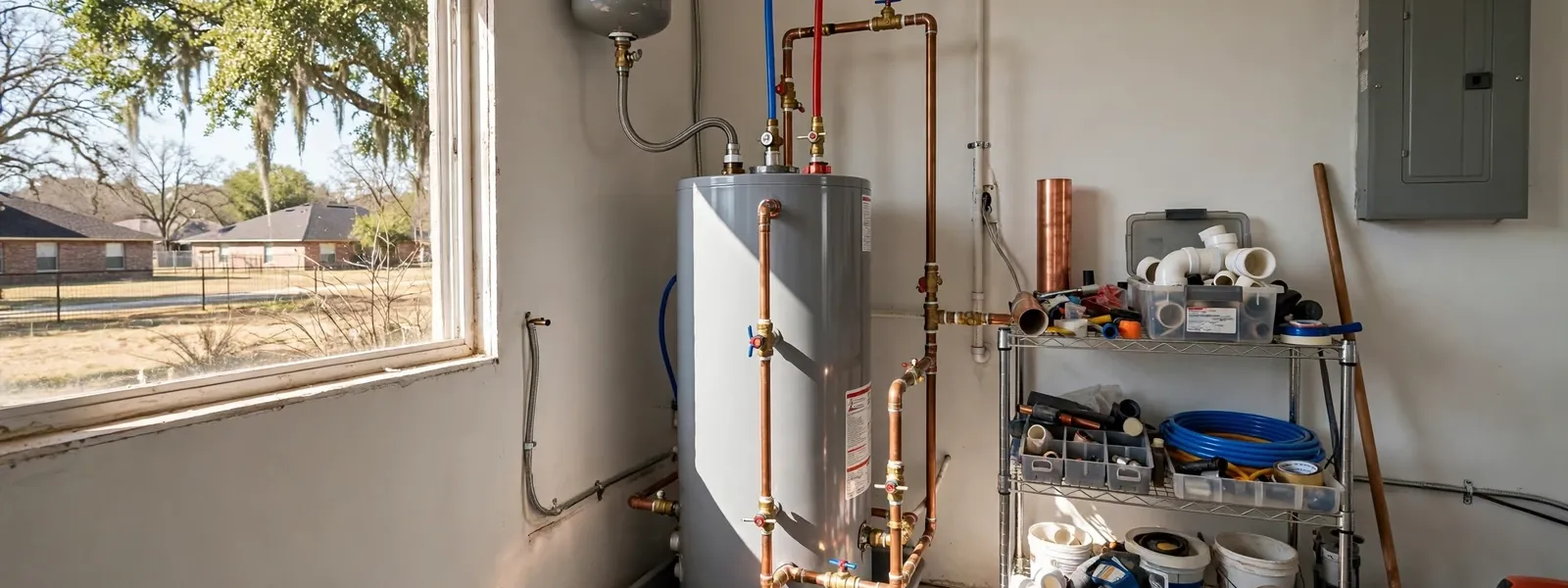
A planned water heater installation in Newark, DE is mostly about the parts around the tank. The heater is one piece. Sizing, venting, the expansion tank, the shutoff valves, the drain pan and the relief valve piping decide whether it runs safely.
This page walks through those pieces in the order a plumber thinks about them, then covers permits and what Delaware law lets a homeowner do. If your heater has already failed and the floor is wet, the emergency replacement page is the faster read.
You get the price in plain terms before work begins, and a same-day visit is possible when openings exist.
Choosing the right size
Capacity is a balance between how many people live in the house and how they use hot water. A household that showers back to back in the morning needs a larger first-hour rating than one that spreads use through the day. The first-hour rating, printed on the unit's label, tells you how much hot water the heater can deliver in a busy hour, and it matters more than the tank size alone.
A tank that is too small runs out, and one that is too large keeps extra water hot. The City of Newark's permit application asks for the water heater size in gallons, whether it is electric or gas, its location and the vent type, so those four facts are worth settling before anyone orders a unit.
Location counts too. A heat pump model wants at least 1,000 cubic feet of air space and a room that holds 40 to 90 degrees Fahrenheit all year, according to the US Department of Energy. NOAA's 1991-2020 normals put the January low near 25 degrees Fahrenheit at the Newark Ag Farm station, so an unheated garage can drop below that band in winter.
Venting and combustion air
Natural draft
The older style relies on a chimney or flue to pull exhaust up and out. An oversized or cold chimney can let exhaust spill back, so the flue is checked and sometimes relined.
Power vent and direct vent
A fan pushes exhaust through plastic pipe, often out a side wall, which frees you from the chimney. These units need electricity and a clear exterior path.
Condensing models
Very efficient units produce acidic condensate that needs a proper drain, and they use special vent materials.
Combustion air
A gas burner needs enough air from the room. A water heater boxed into a tight closet may need louvers or ducted air.
Where an older heater vents into a masonry chimney, the replacement may need a smaller liner, or the vent may be rerouted through a side wall. New Castle County's replacement water heater checklist asks that the existing chimney be cleaned and sized properly and that the gas line and valve be leak-checked.
Carbon monoxide is the reason venting is not a corner to cut. The State Fire Marshal advises a CO alarm on every level and outside bedrooms, plus a yearly professional chimney and vent inspection.
Expansion tanks and thermal expansion
Water takes up more room when it is heated. In an open system, that extra volume pushes back into the city main. Many homes now have a check valve or pressure-reducing valve that keeps it from going back, which makes the plumbing a closed system. The expansion has nowhere to go, pressure spikes each time the heater fires, and the relief valve may drip or the fixtures may wear out early.
An expansion tank gives the water somewhere to go. It is a small tank with an air cushion that attaches to the cold line near the heater, and its air charge must match your home's water pressure or it will not do its job. A Division of Public Health homeowner handout says storage heaters on public water systems need one, and Newark's water is a public system.
A relief valve that drips on a heater with no expansion tank is a classic sign. If yours drips now, the page on repairing a leaking heater explains how to read it.
Valves, drain pan and relief piping
| Part | What it does | Detail to expect |
|---|---|---|
| Cold-water shutoff | Lets you isolate the heater for service | A full-port ball valve is easier to use than an old gate valve |
| Gas shutoff | Stops fuel at the appliance | A licensed professional sets the gas connection and tests it for leaks |
| Drain pan | Catches a leak before it reaches the floor | State guidance calls for an approved pan under storage heaters |
| Relief valve piping | Carries discharge safely away | Full size, no valves or caps on it, running downhill to an approved spot |
| Water connections | Join the heater to the house piping | Metal pipe or an approved flex connector for the first 12 inches |
An inspector looks at all of these. The pan matters most in basements with finished space nearby, where a modest leak ruins drywall.
Planning water heater installation?
Call to book a same-day appointment when one is available. You get a clear price before work starts.
When to call a plumber right away
- A rotten-egg smell by the heater. Walk out, and let the gas utility and 911 hear about it from the yard.
- A carbon monoxide alarm goes off. Move everyone to fresh air and call 911.
- The relief valve discharge pipe runs hot water or steam. Stay clear, because the water can scald.
- Water pools around the tank. Close the cold supply and turn off the power or gas before calling.
Permits and inspection steps
Permit rules depend on where your house sits.
- Identify the authorityLook up your county parcel number. If it starts with 18, the City of Newark issues the permit. If not, the permit comes through New Castle County Land Use, which has its own paperwork for swapping a heater.
- Confirm which permit appliesWater heaters appear in the City's list of permit work, but the wording stops short of saying a like-for-like swap needs one. Put that question to Code Enforcement.
- Submit the applicationThe City's form collects the size in gallons, fuel, location and vent type. It notes that permits take one to two weeks to process, so plan around that for a non-urgent install.
- Install to the adopted codeThe City and the state name different International Plumbing Code editions, so ask which governs your parcel.
- Schedule the inspectionUnder the state sequence, the final inspection comes after fixtures are set and the water heater is operating. Keep the permit number handy when you request it.
What a homeowner may do, and where that stops
Delaware requires a licensed master plumber for plumbing services under Title 24, Chapter 18, with one narrow exception. The carve-out is in 24 Del. C. 1807(c)(2). An owner may handle non-gas plumbing at home if the house is not for sale or partly rented, and only after a permit application is on file.
The state regulation narrows it again, to an owner-occupied single-family house. Gas piping is outside the exemption, so a gas heater's fuel line is not a homeowner job. If you rent out any part of the house, the exemption is gone, which matters for landlords in Bear and elsewhere. You can check a plumber's license before any work begins.
What shapes the price of an installation
Replacing a working heater is not an insurance matter. Homeowners coverage tends to respond to sudden, accidental water damage rather than age or a slow leak, so read your own policy if water has already caused damage. Call with the model, fuel and location, and the plumber can give you a real number.
Questions about water heater installation in Newark, DE
Count the people, the bathrooms and how often hot water runs at the same time. Then compare the first-hour rating on the label, not just tank volume.
The State Division of Public Health says storage water heaters on public water systems need one, and Newark's water is public. Your plumber can confirm whether your home is a closed system and set the tank's air charge to your actual pressure.
Often, but a move means new piping, possibly new gas or electric runs, and a new vent path. That is more than a swap and likely needs a permit, so confirm with Code Enforcement or County Land Use.
The City's permit page indicates processing can take one to two weeks. That suits a planned install and fits a failed heater poorly, so if your tank has already failed, say so when you call.
Usually, because gas adds venting, combustion air and a licensed gas connection with a leak test. Electric installs lean on circuit and breaker size instead.
It depends on gas line capacity, venting and how you use hot water. The tankless water heater page lays out when it pays and when it does not.
Need a plumber instead of an answer?
Call (410) 378-7601