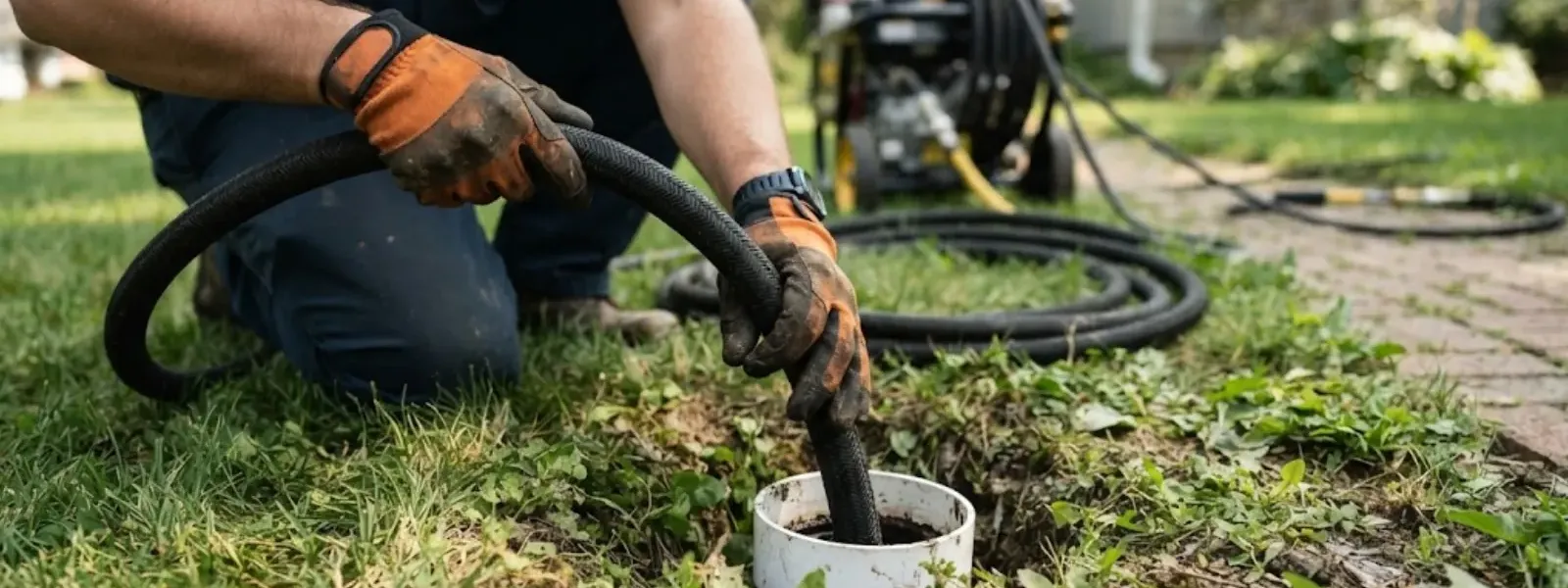
If a drain line is backing up right now, stop running water and keep everyone out of any room with sewage on the floor. For emergency hydro jetting in Newark, DE, dispatch runs 24/7 and a licensed plumber is assigned when a line needs more than a cable can do.
Hydro jetting sends water through a hose and a special nozzle at pressure high enough to scour the inside of a pipe. It washes away grease, soap film, sediment and fine roots instead of boring a hole through them. The result is a pipe wall that is clean, not just open.
Jetting is not the answer to every clog, and an honest plumber will say so. Below: when it earns its place, when it does not, and what should happen first.
The drain was snaked and clogged again
This is the most common reason people look into jetting. A cable punches a hole through a blockage and the water drains, but the buildup on the pipe wall stays behind. Grease and soap scum keep narrowing the opening until the next stoppage, often weeks or a couple of months later.
A jet nozzle has several rear-facing ports that pull the hose forward and spray the pipe wall in a full circle. The water strips grease and scale off the surface and carries the debris down to a point where it can flow out.
If you have already paid for a cable cleaning twice on the same line, ask the plumber whether the problem is buildup or a physical defect. A defect such as a belly (a low spot that holds water) or a broken joint will keep catching waste no matter how clean the wall is.
A slow main line and a gurgling basement drain
When the main line slows down, symptoms show up in several places. A basement floor drain gurgles when the washing machine runs, a toilet bubbles when the tub empties, and fixtures on the lowest level are the first to back up.
Jetting is well suited to this kind of long, evenly coated line because it cleans a long stretch in one pass instead of clearing only the spot where the cable stalled. Before the work starts, the plumber should find out where the line runs, where the cleanout is, and whether the blockage is on your side of the property line. Our page on sewer line cleaning covers what to expect when the trouble reaches the lateral.
Roots in the line
Roots do not break into healthy pipe. They find a hairline crack or a loose joint, grow through it toward the moisture and nutrients inside, and fill the pipe with a hairy mass that catches everything that follows. According to the EPA, roots entering through defects or openings in a sewer line can cause blockages, so the crack matters as much as the clog.
A cable with a cutting head can chop roots near the opening, and a jet with a rotating nozzle can clear finer roots from the entire pipe circumference. Neither fixes the crack the roots came through. Roots will usually return unless the joint is repaired, which is why a camera look is worth the time. Our page on sewer line repair covers the options once the plumber has found the entry point.
Newark Municipal Code Sec. 25-2 splits root responsibility between the owner and the City. The owner clears roots in the lateral where no cleanout exists at or near the property line, and the City clears roots from the property line to the main where such a cleanout does exist. If you are unsure which situation applies, ask the plumber to find your cleanout before the work begins.
Jetting compared with cabling
| Question | Hydro jetting | Cable (snake) |
|---|---|---|
| What it does | Scours the full pipe wall with water | Bores or hooks through the blockage |
| Best for | Grease, scale, sediment, fine roots, repeat clogs | Fresh clogs, hair, paper, a single stuck item |
| Weak spot | Cannot clear a solid object or fix a broken pipe | Leaves buildup on the pipe wall |
| Access needed | A cleanout or open pipe end large enough for the hose | Almost any drain opening |
| Risk to old pipe | Higher on cracked, thin or deteriorated pipe | Lower, but can snag on defects |
Water where it should not be?
Close the nearest shutoff, then call. We answer around the clock.
When jetting is the wrong tool
The plumber who comes out should say plainly if your pipe is not a good candidate. Jetting moves water, and water goes out through any hole in the pipe. A collapsed section, a badly offset joint, or a pipe that has lost its bottom to rot will not be fixed by cleaning. Pressure on a weakened pipe can make the damage worse or push water into the soil around it.
That is the reason a camera comes first when the history is unclear. If the line has failed repeatedly, if the house is older, or if you are buying the property, a sewer camera inspection shows what condition the pipe is in before any pressure goes into it.
Jetting also cannot wash apart a hard object such as a toy or a stone in a lateral. Those need a retrieving tool or a spot excavation.
Pipe material matters
Different pipe materials tolerate the process differently. The notes below are general, and the plumber should set pressure and nozzle choice for what is actually in the ground.
PVC and ABS plastic
These smooth, newer pipes take jetting well, with the plumber keeping pressure moderate at joints and fittings.
Cast iron
Older cast iron can be scaled and flaking inside, and jetting can release those flakes. Heavy rust or thin walls call for a camera first and a lower pressure.
Clay and concrete
Joints in old clay lines can be loose or offset. A jet can wash soil in through a bad joint, so inspection helps decide whether cleaning or repair makes more sense.
Fiber or deformed pipe
Soft pipe can fail under jetting and usually needs repair or replacement instead of cleaning.
Backing up tonight? What to do first
- Stop using water. Every flush and every load of laundry adds to the problem.
- Keep children and pets out of any area with sewage. Stay out of it yourself, and if you must pass through briefly, wear waterproof boots and gloves and wash your hands afterward.
- Stay out of standing water near outlets or appliances, and call the dispatcher if you see it.
- Find your cleanout if you know where it is, and tell the dispatcher whether it is accessible.
- Skip chemical drain openers. They do not clear grease at the volume that backs up a main, and they add a hazard.
After-hours and weekend calls get three questions: how many fixtures are affected, whether there is a cleanout, and whether this has happened before. Same-day visits happen when the schedule has room.
What affects the price of jetting
Insurance rarely pays to clean a pipe. Homeowners policies usually respond to sudden and accidental loss, not to buildup or aging pipe, and the City's sewer guide warns that many exclude sewage backup, so read your own policy. Ring in for your actual figure and you will hear a clear price before work starts.
Hydro jetting questions, answered
Our lines are staffed 24/7, so a main line that starts backing up on a Saturday night gets the same intake as a Tuesday morning call. Tell the dispatcher how many fixtures are affected and whether a cleanout is reachable.
It depends on the pipe. Sound PVC and well-kept cast iron generally tolerate it. Cracked clay, thin cast iron and deteriorated fiber pipe may not, which is why a camera look can come before the jet.
There is no set interval. A line cleaned of grease may stay clear for a long time if you manage what goes down the drain. A line with a root entry or a low spot can clog again until the underlying defect is repaired.
It clears roots from inside the pipe but does not repair the crack they entered through. Roots can regrow unless the joint is fixed, lined or replaced.
For a fresh, single-fixture clog, yes. A cable is quicker and costs less. Jetting becomes the better choice when the same line has clogged repeatedly, when the buildup is grease or scale, or when the clog is in a long main line.
No. Jetting cleans, it does not repair. A collapsed or offset pipe needs a spot repair, lining or replacement. The plumber should show you the camera footage that explains the finding.
Need a plumber instead of an answer?
Call (410) 378-7601