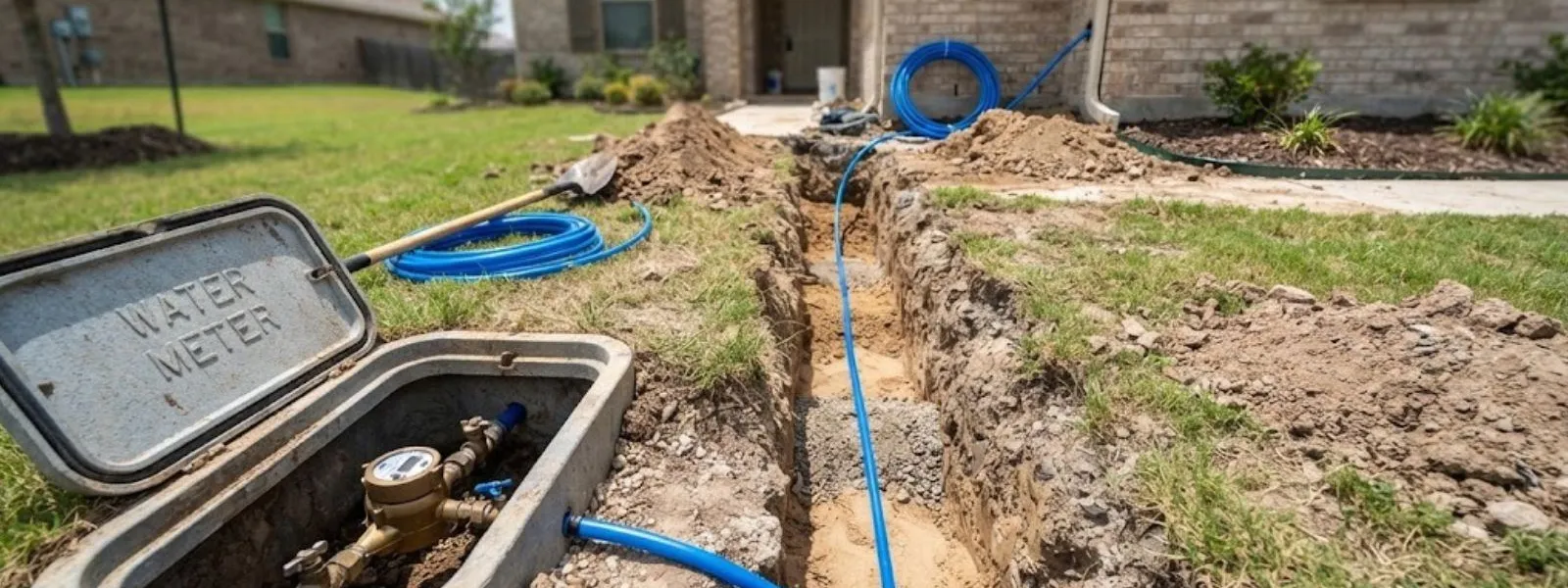
If the pipe that feeds your house has broken, water is leaving the system before it ever reaches a tap. Calls for water service line repair in Newark, DE are answered 24/7, and a licensed plumber comes out to locate the break and make it safe. Until then, turn off the main valve inside the house, avoid walking on a soggy or sunken patch of yard, and keep children and pets off it.
The service line is the buried pipe that runs from the City's water main, past the curb stop and meter, to where it enters your house. Because it is underground, the first sign is often in the yard or on the meter. Below: how to spot a failing line, who owns which stretch, and how the repair is done.
Water service line leak right now: what shows up in the yard and at the meter
A wet strip with no rain
Grass that stays green and soggy in dry spells, or a patch of mud between the street and the house, can mark the break. Newark gets roughly 47 inches of precipitation a year, so check after a dry week before blaming a pipe.
A meter that moves with everything off
Close every tap and appliance, then watch the dial or leak indicator. Movement means water is going somewhere.
Sound near the meter or main
A hiss or rush near the foundation wall where the line enters the house suggests a pressurized leak close to the building.
Cloudy or muddy water
A break lets soil in when pressure drops. Run a cold tap for a minute and note whether it clears.
A sinking spot or a cracked walk
Escaping water can wash soil away and leave a void under the lawn or paving.
Some breaks never surface because the water drains into gravel or soil. For a hidden break, start with leak detection so the dig happens once, in the right place.
Low water pressure: is the service line the cause?
Weak pressure at every tap in the house is a different problem from weak pressure at one faucet. When it affects the whole house, the supply line is a prime suspect, along with a partly closed valve, a failing pressure regulator or old pipe choked with buildup. A one-fixture problem is usually a clogged aerator or cartridge and has nothing to do with the street.
Quick checks help. Confirm the main valve inside the house is fully open, and compare hot and cold, since weak hot water alone points at the water heater. Ask a neighbor whether their pressure dipped too, because work on the City's main can affect several homes at once.
A plumber can put a gauge on an outdoor spigot and compare static pressure with the reading while water flows. A big drop between the two points to restriction or a leak. If pressure sags over weeks while the bill rises, a slow leak is more likely than a clog.
Where the City's pipe ends and yours begins
The City's water department maintains the main in the street and the meters. The homeowner owns the pipe on the private side. Exactly where one becomes the other is not something this page can state for your street, so put the question to Newark's Public Works and Water Resources department before you pay for a dig.
One clue exists. For frozen service lines, Newark's code divides the duty at the curb box shut-off valve: City from the main to that valve, owner from there into the property. Treat that as a starting point, not a ruling on every kind of leak.
If water is gushing, a burst pipe shutdown is the faster response. If the street-side shut-off is needed, the City will close it at the curb once a repair is scheduled, so contact the City's Water Resources team.
Lead and copper: check the City's page, do not assume
Older service lines can be lead, copper or galvanized steel, and newer ones are usually copper or plastic. According to Newark's Lead and Copper Rule page, the work includes an inventory of service lines on both the public and private side and a customer survey. What it shows for a given address is not something this page can say.
So read the City's page and any survey results for your own address instead of assuming the line is safe or unsafe. If the pipe is exposed during a repair, ask the plumber what material it is. A replacement is also the moment to choose the new material, so ask what is going in and why.
Water where it should not be?
Close the nearest shutoff, then call. We answer around the clock.
Trenchless or open trench: how the repair is done
| Factor | Trenchless | Open trench |
|---|---|---|
| Yard and driveway disruption | Two small access pits, usually | A continuous trench along the line |
| Typical use | Full replacement of a long run | Spot repair or a short, shallow run |
| Limits | Depends on soil, depth, bends and the old pipe's condition | Needs room and clear access to dig |
| Restoration afterward | Patch two pits | Backfill, compact and reseed or repave the full trench |
| Visibility of the old pipe | Seen only at the pits | Whole run is exposed |
Trenchless methods pull a new pipe along the old path or bore a new one, and they do not suit every line. A short dig is often simpler than a trenchless setup, and the plumber should explain why one method is recommended.
Before anyone digs: utilities, permits and who to call
- Have the plumber or you contact Miss Utility of Delmarva through call811.com so buried lines are marked. The state says to do this at least three days before digging.
- Ask whether the work needs a permit. Parcels with a New Castle County parcel number starting with 18 go through the Newark Code Enforcement Division, and all others go through New Castle County Land Use.
- Check that the plumber holds a Delaware license at the state lookup before any dig.
- Ask where the old pipe will end up and what pipe material is going in.
Homes just outside the city, such as those in Bear, fall under County rules, which changes who issues the permit.
Meter-box and yard leaks, in short
A damp ring around the meter pit lid, or water inside the box, may come from a City fitting or an owner fitting. Do not open the lid and tighten anything, since the parts belong to different parties. Report it to the City and have a plumber check your side. Hose bibs and sprinkler lines can also soak a lawn, so they get ruled out before anyone digs.
Repair or replace the service line
A single leak in an otherwise sound line is a candidate for repair. If the line is old, has failed before or is a problematic material, replacing the run avoids paying for the same dig twice. Replacement costs more today, while repeat spot repairs cost less each time but keep tearing up the yard. When interior pipes are in poor shape too, whole-house repiping may belong in the same conversation.
What drives the cost of service line repair
Whether a policy covers a buried service line depends on the policy, so ask your agent. Call for your actual figure and expect a clear price before work starts.
Water service line FAQ
Yes. Someone is on the phones around the clock, 24/7, and a plumber can be sent after dark or on a holiday. A line flooding a yard or basement gets an urgent response. A slow weep can often be scheduled for same-day service when available.
It depends where the break sits. The City maintains the main, and its code splits duty for frozen lines only at the curb box valve, which does not settle other leaks. Ask the water department where its side ends before paying for anything.
Shut the main valve inside the home and watch the meter. If it keeps running, the leak is outside the main valve, which points to the service line. If it stops, the problem is on the house side.
Delaware generally requires a licensed master plumber. The homeowner exemption has limits, needs a permit application, and does not cover gas piping. A buried line also needs utilities marked before any digging.
It depends on the route and method. Trenchless work can limit the damage to two access pits, while an open trench disturbs the whole path. The plumber should show you the planned route first.
We cannot tell you without seeing the pipe, and no one should assume. Check the City of Newark's Lead and Copper Rule page and your survey results, and ask the plumber to identify the material if the pipe is exposed.
Need a plumber instead of an answer?
Call (410) 378-7601