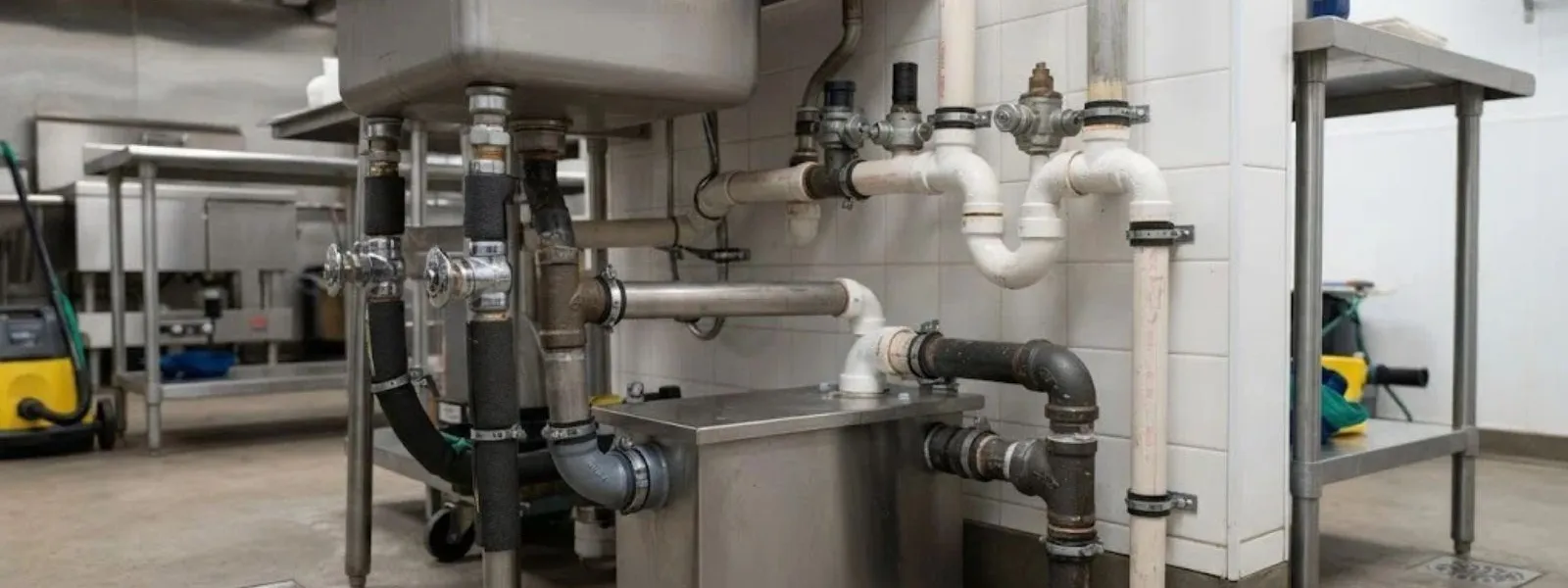
A backed-up floor drain in a kitchen, a burst line over a shop floor or a dead restroom during opening hours costs money by the minute. Emergency commercial plumbing in Newark, DE runs 24/7, so a call after closing reaches dispatch and a licensed plumber. While you wait, close the nearest shutoff valve, keep staff and customers off wet floors, and stop using any fixture that is draining slowly.
Commercial plumbing differs from house calls because more people share the pipes, and the building owner, the tenant and the property manager may each have a say. This page covers the urgent cases and the recurring maintenance that heads them off.
Business drain backing up after hours
Commercial drains carry more load than a home. Kitchen waste, mop water, restroom traffic and floor sinks all feed lines that were sized for an earlier use. When one backs up, the first move is to stop adding water, which means pausing dishwashers, handwashing and restroom use on that branch.
Check whether one fixture or several are affected. A single slow sink points to a local clog, but several fixtures gurgling or overflowing together mean the main building drain is restricted. A plumber can then clear it with a cable or hydro-jetting equipment and run a camera to see why it blocked.
Repeat blockages in commercial lines usually have a cause that cable work alone does not fix, such as a belly in the pipe, roots in an old lateral or grease buildup. For the building-to-street portion of the line, see sewer line cleaning.
- Stop the water sourcePause dishwashers, close fixture valves and put out wet-floor signs.
- Find the patternNote which drains are slow and which are fully blocked.
- Protect stock and equipmentMove inventory, electronics and paper off the floor.
- Call the owner or managerA landlord may control the main line or hold the maintenance contract.
- DocumentPhotograph standing water and note the time for insurance.
Services to ask us about for businesses
| Service | What it covers | Why it matters |
|---|---|---|
| Emergency drain work | Floor drains, floor sinks, restroom and kitchen lines | Stops downtime and sanitary hazards |
| Backflow testing | Annual testing of installed assemblies | Required for owners of assemblies in Delaware |
| Grease trap cleaning | Pump-out and inspection of interceptors | Prevents greasy blockages and odors |
| Storm drain cleaning | Lot, roof and area drain lines | Keeps heavy rain off floors and entrances |
| Leak finding | Pressure checks and tracing | Short, honest scope, see below |
Backflow testing
Backflow assemblies protect the public water supply from contamination. The Delaware plumbing regulation, 16 DE Admin Code 4455, states that owners of backflow assemblies must test them at least annually, as an amendment to the IPC. That duty falls on the owner, so a tenant should ask the landlord who holds the test records.
A licensed plumber can test the assembly, repair or replace worn relief valves and check valves, and file the report. Missed tests are easy to overlook because the assembly sits in a mechanical room or ceiling. Newark has a cross connection control program under the state backflow rules, so ask the City which reports your building must file.
Grease trap cleaning
Restaurants, cafeterias and food-prep kitchens often have a grease trap or interceptor that catches fats before they reach the sewer. A full trap lets grease pass into the lateral, where it cools and hardens. The City of Newark's sewer guide advises against putting fats, oils and grease down drains, and the owner is responsible for stoppages the building causes in its lateral.
Pump-out frequency depends on how much you cook and how large the trap is. A plumber can also look for broken baffles and failing lids. Whether your business needs a specific program is a question for the City, because Newark did not adopt New Castle County's commercial FOG section into its own code.
Water where it should not be?
Close the nearest shutoff, then call. We answer around the clock.
Storm drain cleaning
Parking-lot inlets, roof leaders and area drains fill with leaves, silt and trash, so rain pools at doorways. The City says much of the flooding in Newark comes from storm system capacity limits during heavy rain. A clean private drain cannot fix that, but it keeps your own site from being the weak link.
Newark's code bars connecting stormwater, sump pump discharge and subsoil drains to the sanitary sewer. A plumber will check where a drain actually goes, and a camera can show whether an old connection was ever tied in the wrong place.
Leak detection for commercial buildings
Finding a hidden leak is useful, but results vary by building and pipe layout, so we keep expectations plain. A plumber can isolate zones, pressure test sections and use sensing tools to narrow where water is going. Large buildings with slab runs or shared walls may need more than one visit. See leak detection for how that process works.
Older buildings and Main Street
The City's plan describes older Newark areas as built with a more traditional, denser design. In an older mixed-use building, drain lines may be shared between units or run in ways no drawing shows. A camera inspection before cutting into a floor or wall saves guesswork and helps identify which unit's pipe is at fault.
Property managers and landlords
Responsibility in a multi-tenant building depends on the lease. Common-area lines and the main drain are usually the landlord's, while fixtures inside a unit may be the tenant's. Document who approved the call.
A plumber needs access to ceilings, mechanical rooms and cleanouts, so line up keys and a contact before arrival. Keep written records of tests, pump-outs and repairs, because insurers and the City may ask for them.
Delaware law requires a licensed plumber for plumbing services on rental property or any part offered for rent, and Newark requires a contractor license for paid plumbing work. Check licenses at delpros.delaware.gov. Work for businesses in Brookside and other areas outside the city often falls under county permitting, and the Brookside page lists those towns.
What affects the cost of commercial work
Commercial property policies vary widely, so review yours with your agent. Delaware's Department of Insurance says standard business policies do not cover floods. Call us for your real number, and the plumber will give a clear price before work starts.
Commercial plumbing questions
Yes. Dispatch is open 24/7, which covers a restaurant kitchen backing up on a Saturday night or a pipe failing in an empty shop. Same-day appointments are offered when available.
Under the Delaware plumbing regulation, the owner of the assembly must have it tested at least annually. A qualified tester does the testing, and a landlord usually keeps the report.
Read the lease first, since it decides who pays for what. Tell the landlord right away and keep receipts, because common lines are often the landlord's responsibility.
It depends on kitchen volume and trap size, so no single schedule fits every business. A plumber can judge how full the trap is and recommend an interval.
Ask us about it, as a limited service. Results vary with the building, pipe materials and layout, and a hidden leak under a slab can take more than one visit.
Yes. Delaware's homeowner exemption does not cover a home with any part rented, and Newark requires a licensed contractor for paid plumbing work.
Need a plumber instead of an answer?
Call (410) 378-7601