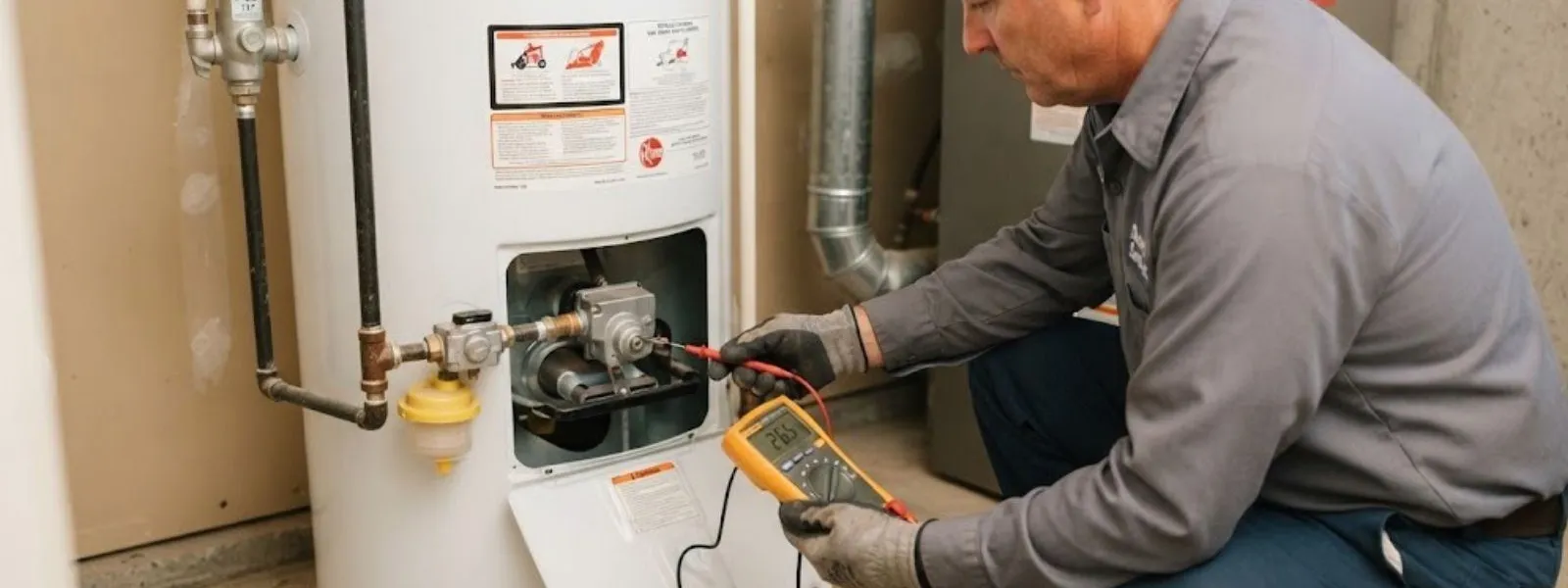
When a water heater floods a utility room or quits in the middle of a cold night in Newark, DE, it cannot wait for the next business day, and our 24/7 line sends a licensed plumber. While you wait, kill the breaker or set the gas control to off, shut the cold supply at the top of the tank, and stay out of any standing water.
Most repair calls come down to a short list of parts: a valve, an element, a thermostat, a pilot or igniter, a dip tube or an anode rod. Some are quick work. Others warn that the tank is finishing its life, and a good plumber will say so.
Calls that come in after hours or on a weekend are answered the same way, with same-day appointments when available. Homes from Glasgow to Brookside are reached from the same dispatch, and the Brookside page lists what to expect there.
If you smell gas or see a flame out of place
Gas comes first, ahead of any other repair. If you smell gas, walk out at once and do not stop to lock up. Phone the gas utility and 911 from the yard, the sidewalk or a neighbor's house, and skip light switches and indoor phones. Call a plumber only after the gas company clears the home.
Gas piping and gas controls belong to licensed professionals. Delaware's homeowner exemption for plumbing excludes gas piping, so the shutoff valve and the line feeding your heater are not a do-it-yourself job.
Scorch marks, soot near the burner or a lazy yellow flame can signal poor combustion air or venting. Turn the unit off and have it examined, since those conditions can let carbon monoxide into the house.
Where a leaking water heater is leaking from
A wet floor does not always mean a failed tank. The spot where water first appears tells the plumber a lot, so dry the area and note where it returns.
| Where it drips | What it often means | Repair or replace |
|---|---|---|
| Relief valve or its discharge pipe | Pressure from thermal expansion, a worn valve or an overheated tank | Usually repair, after finding out why it opened |
| Drain valve at the bottom | A worn plastic or brass valve that weeps | Repair, a quick swap |
| Pipe fittings on top | Loose or corroded connections, failing unions | Usually repair |
| Under the jacket or from the tank seam | Rust has opened the steel shell | Replace |
The temperature and pressure relief valve is a safety part, not a nuisance. It is meant to open if the tank gets too hot or too pressurized. Never cap or plug its discharge pipe. If it drips every time the heater runs, the usual culprit is thermal expansion in a closed system, which an expansion tank can address. Our planned installation work explains how that fix fits into a tank setup.
Sweating can mimic a leak. Cold pipes collect condensation on humid days and drip onto the tank or pan. If the dripping stops when the weather dries, the heater may be fine.
No hot water or only lukewarm water
The cause depends on the fuel, so the fix does too.
Electric tank, no heat at all
A tripped breaker, a tripped high-limit switch or two dead elements are the common causes. The breaker is safe to check. The access panels hide live wiring, so leave them to the plumber.
Electric tank, lukewarm or short supply
One of the two elements has often failed, usually the lower one, or the thermostat is misreading. Scale on an element lowers its output long before it burns out.
Gas tank, pilot out or burner will not light
A weak thermocouple, a dirty pilot assembly, a failing igniter or a faulty gas control can all shut the burner down. A blocked flue can too, which is a safety problem as well as a comfort one.
Either fuel, runs out fast
Sediment piled in the bottom of the tank takes up space and insulates the water from the heat source. A cracked dip tube can also send cold feed water straight to the outlet instead of the bottom.
If the pilot is out, do not keep relighting it. A pilot that goes out repeatedly can signal a draft, a failing thermocouple or a venting problem, so have a licensed plumber check it. If you smell gas at any point, treat it as a gas call. Hot water that turns cold in the shower and warms again can also point to a valve in the shower itself, so the plumber may check a mixing valve before blaming the tank.
Rumbling, popping and other noises
Rumbling or popping from a tank is usually sediment. Minerals settle in the bottom, water trapped underneath boils and bubbles up through the layer, and the tank gets noisier and less efficient as the layer grows. A flush can help a younger tank. On an old, heavily scaled one it can start leaks.
Sizzling often means water dripping onto a hot burner or element, so it ties back to a leak. Ticking is generally expansion in the pipes. A sharp bang when a faucet closes is water hammer, and that is a pipe issue rather than a heater issue.
Scale builds faster in harder water, and hardness differs from one address to the next. A test strip on your own tap tells you more than a citywide guess, and the City's Public Works and Water Resources office publishes yearly water quality reports.
Water where it should not be?
Close the nearest shutoff, then call. We answer around the clock.
Gas, electric and hybrid water heater repair
Each type of unit fails in its own way, and the repair parts differ.
A gas heater depends on a flame, a flue and a gas control. Its repairs cluster around the pilot assembly, thermocouple or igniter, the burner, the gas control valve and the vent. Venting matters because exhaust has to leave the house. Anything that touches gas piping or the control goes to a licensed professional.
An electric heater depends on elements, thermostats and the high-limit switch. The work is simpler but the wiring is live, and a wrong replacement part or loose connection can cause a fire. Power is switched off at the breaker first, and tested before anyone touches a wire.
A hybrid (heat pump) heater adds a compressor, a fan, an air filter and a condensate drain on top of the tank and the backup elements. Common service issues include a clogged filter, a blocked condensate line and error codes that the manual explains. They also need open space around them, so a closet stuffed with boxes causes trouble.
Repair or replace: a rule of thumb
- The tank is leaking from the body or seam, not a valve or fitting: replace it, because steel cannot be patched.
- The unit is past roughly 10 to 15 years, the range the Department of Energy gives for storage tanks, and the repair is anything beyond a simple valve or element.
- The repair price is a large share of a new unit's price and the heater is past the middle of its life: put that money toward a new one.
- The unit is young, the failure is a single part and the tank itself is dry and sound: repair it.
- It has needed repeated visits in a short span, or the water runs rusty: expect a replacement conversation.
An anode rod is worth knowing about. This sacrificial rod corrodes in place of the tank steel, and replacing it on a younger tank can extend its life. On an old tank with a pitted lining it does little. If you are leaning toward a new unit, the page on emergency water heater replacement explains tank, tankless and heat pump choices, and the tankless water heater page covers the case for a switch.
What to do while you wait for the plumber
- Cut power or gas to the heater and shut its cold supply.
- Photograph the leak, the data plate and any error code for the plumber and for insurance.
- Clear the area around the heater so the plumber can reach the valves.
- Do not drain a hot tank onto the floor, and do not plug the relief valve discharge.
- If the water must be shut off at the street, the City of Newark will do it once a repair is scheduled.
January lows average about 25 degrees Fahrenheit at the University of Delaware's Newark Ag Farm, according to NOAA's 1991-2020 normals. A heater in an unheated garage, porch closet or crawl space can lose a pilot to drafts, and an exposed fitting can fail in a hard freeze. Ask the plumber about draft protection.
What affects the price of a water heater repair
Standard homeowners coverage generally responds to a sudden burst, not to corrosion or a slow drip that went unnoticed, and policies differ, so read yours before filing. For your real number, call and describe the unit.
Questions about water heater repair in Newark, DE
Calls reach us around the clock, and a licensed plumber is sent for leaks, gas concerns and a total loss of hot water. Same-day appointments are offered when available. Cut the fuel or power first.
The most common sources are loose or corroded fittings and the relief valve. Condensation on cold pipes can look the same. If the water is dripping from connections, a repair may do. If the leak seems to come from inside the jacket, assume the tank is failing.
It can be a warning that pressure or temperature is too high, so do not ignore it or plug it. Often the cause is thermal expansion, which a plumber can correct. If the valve discharges steam or hot water forcefully, turn off the heater and call right away.
On electric tanks a failed lower element is common. On either fuel, sediment or a broken dip tube can reduce the usable hot water. A shower mixing valve can also be the cause. The plumber tests the unit to separate these.
Simple checks like a breaker are fine. Delaware allows homeowners to do some plumbing in their own non-rental home if a permit application is filed, but gas piping is excluded, and electric work carries real shock risk. Many owners hire a licensed plumber for anything past a reset.
State law ties plumbing work to a master plumber license. The state license lookup lets you check a name before work begins.
Need a plumber instead of an answer?
Call (410) 378-7601