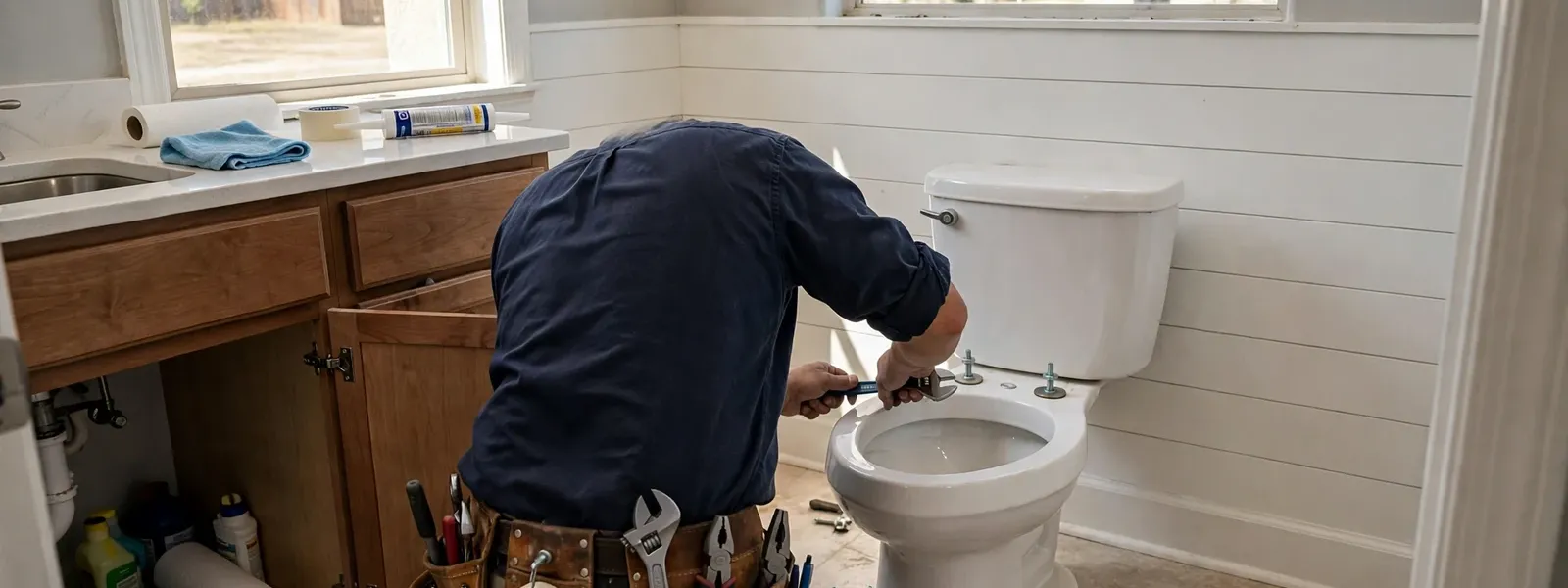
A toilet that is overflowing, leaking at the base or refusing to stop running can put water through a ceiling in minutes. Our line is open 24/7 for emergency toilet repair in Newark, DE, and a licensed plumber can come out once you call. While you wait, close the supply valve behind the bowl, lift the tank lid and stop the flapper, and keep people and pets off the wet floor.
Most toilet trouble is a blockage, a worn tank part, or a failed seal under the bowl. Each has a different fix and a different level of urgency.
Water rising in the bowl right now: do these things in order
An overflow is the one toilet problem that cannot wait for morning. The goal is to stop new water from entering the bowl before it reaches the rim.
- Stop flushingEvery extra flush sends more water to a bowl that already cannot drain. Resist the urge to try again.
- Close the supply valveTurn the small oval handle on the wall or floor behind the toilet clockwise until it stops. If it spins freely or will not move, go to step three.
- Lift the tank lidPush the rubber flapper down into its seat with your hand, or lift the float rod, so the tank stops refilling the bowl.
- Move towels and rugsWater that reaches the bathroom door soaks hallway flooring fast.
- Cut the main if neededIf the shutoff valve fails, close the main water valve for the house, usually where the line enters.
Do not pour chemical drain cleaner into a full bowl. It sits in standing water and splashes back when you plunge. Once the water has stopped rising, a flat-bottom plunger with a firm seal is the safe first try.
If the bowl backs up and other drains gurgle too, the trouble is deeper than the toilet. That is a job for drain cleaning, not a fixture repair.
When to call a plumber right away
- Sewage is coming up in a tub or floor drain, which signals a blocked line rather than a toilet problem.
- Water from an overflow is running through a ceiling below. Move people out from under it.
- The shutoff valve and the main both fail to stop the water.
- Dirty water has reached outlets or a power strip. Do not enter the room. If the breaker panel is in a dry area, switch off that room's breaker, otherwise call a licensed electrician or the City electric department.
What the symptom usually means
| What you notice | Likely cause | Typical repair |
|---|---|---|
| Bowl fills slowly or rises when flushed | Partial blockage in the trap or drain | Plunge, auger the fixture, or clear the line |
| Tank hisses or runs after flushing | Worn flapper or tired fill valve | Replace the flapper, fill valve or both |
| Water around the base of the bowl | Failed wax ring or loose closet bolts | Pull the toilet, replace the wax ring, reset |
| Toilet rocks side to side | Bent or corroded flange, or uneven floor | Reset on a repaired flange with shims |
| Water drips from the supply line | Cracked or corroded supply connector | Replace the supply line and often the valve |
A plumber who knows the symptom can bring the right parts on the first trip, so describe what you see and whether the water is clean tank water or something worse.
The wax ring and flange: the repair people put off
A wax ring is the soft seal between the bowl outlet and the closet flange on the floor. When it fails you may see damp flooring, a ceiling stain below, or a smell that comes and goes. Slow base leaks rot subfloor wood for months before anyone notices.
The fix means shutting the water off, draining the tank, lifting the toilet, scraping the old wax and setting a new ring. A cracked or rusted flange, or one sitting below the finished floor after a tile job, needs a repair ring or a new flange so the seal can hold.
A toilet that rocks is working its seal loose with every use. Cranking the bolts tighter usually cracks the porcelain, so a reset with proper shimming is the better answer.
Water where it should not be?
Close the nearest shutoff, then call. We answer around the clock.
Running toilets and weak flushes
Not every call is a flood. A toilet that runs on, hisses or needs two flushes wastes water and usually has worn tank parts.
Flapper
A soft rubber seal that hardens and warps over time. Water slips past it into the bowl, and the fill valve keeps topping up the tank.
Fill valve
Controls how the tank refills. A worn one runs forever, and replacing it is a short job.
Chain and overflow tube
A chain pulled too tight holds the flapper open.
Rim jets
Mineral buildup in the rim holes weakens the flush. Hardness varies by address, so test your tap and ask the City of Newark Public Works and Water Resources for its annual water quality report.
Replacing a toilet instead of repairing it
Repair makes sense when the fixture is sound and a part has failed. Replace it when the porcelain is cracked, the flush stays weak after new parts, or the bowl is an old high-volume model. A hairline crack in a bowl or tank will leak sooner or later, and no sealant holds for long.
Installation covers the flange height, a new wax ring, fresh bolts, and a new supply valve and braided line. A valve that has not been turned in a decade often drips the first time it is closed, so replacing it during the job is cheap insurance. If the same bathroom also has a dripping sink, the faucet repair visit can be combined with it.
If the bathroom sits over a basement or crawl space, a quick look underneath shows how far a base leak has traveled.
Who is allowed to do the work
Delaware law gives homeowners a narrow exemption. Under 24 Del. C. § 1807(c)(2), a homeowner may do plumbing other than gas piping in their own home, as long as the home is not for sale and no part is rented, and a permit application has been filed with the authorized inspection authority. The state plumbing regulation, 16 DE Admin Code 4455, amends the IPC and limits this further to a single-family home the owner occupies.
Newark's code lets fixtures be replaced in kind without a permit when no pipes or valves are moved. Permit rules vary by parcel, so parcels whose number starts with 18 go to Newark's Code Enforcement office, and every other parcel goes to New Castle County Land Use.
Landlords and anyone hiring the work done need a licensed plumber. You can check a license at the state lookup, delpros.delaware.gov, which is run by the state plumbing board.
What affects the price of a toilet repair
Coverage for water damage depends on your own policy, so ask your agent. The City of Newark's sewer guide adds that many policies exclude sewage backup. Call us for your real number, and the plumber will give a clear price before work starts.
Toilet emergency questions
Yes. Our dispatch runs 24/7, so a call at midnight or on a holiday weekend reaches someone who can send a licensed plumber. Same-day appointments are offered when available, and the plumber will tell you the price before work begins.
Not an emergency, but do not wait long. A rocking bowl stresses the wax ring, and the leak often starts under the floor where you cannot see it.
One affected toilet usually means the fixture or the branch line, which is yours to fix. If several drains back up together, the City checks its main under the street, and a plumber handles the lateral if the main is clear. Homes in Brookside just outside the city follow county rules instead, so ask which applies.
Delaware allows it for plumbing other than gas piping in your own non-rental single-family home if a permit application is filed. Ask the permitting office first, because needs depend on what you change.
That depends on your policy. The City's sewer guide says many policies exclude sewage backup. Ask your agent, and photograph the damage before cleanup begins.
Need a plumber instead of an answer?
Call (410) 378-7601