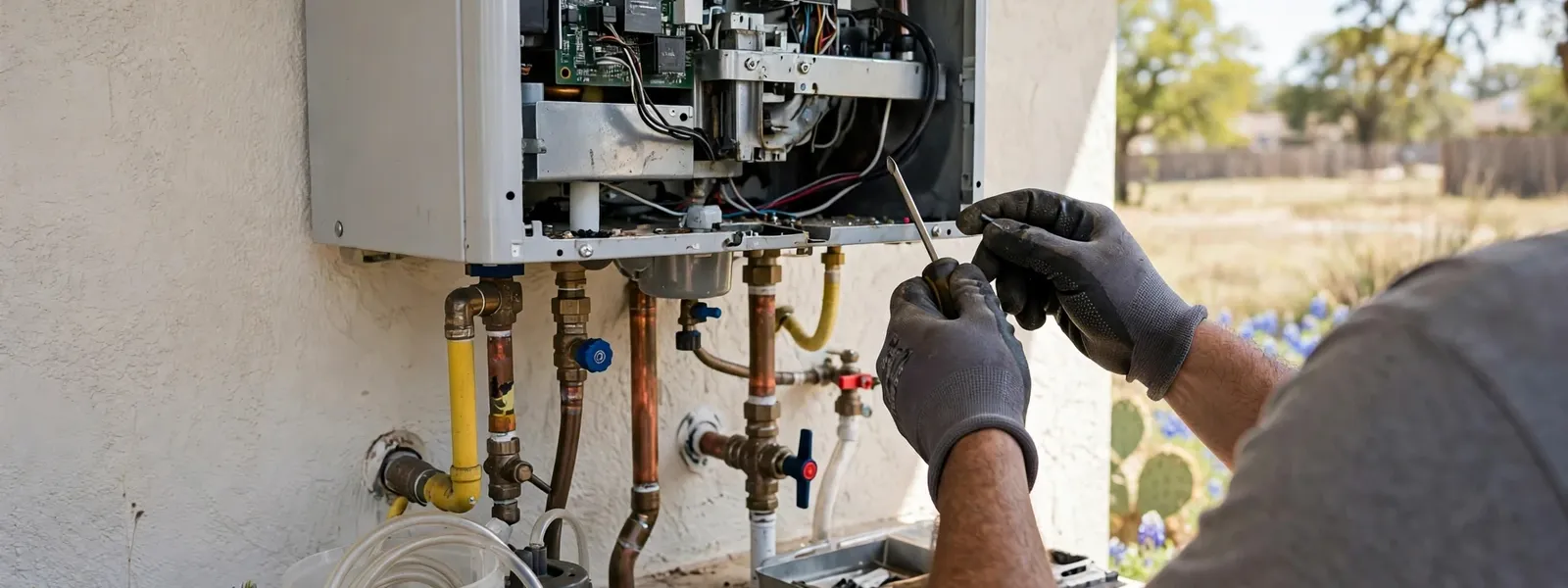
A tankless water heater heats water only when a tap opens, so there is no tank to leak, rust out or keep hot overnight. For the right Newark, DE household that means continuous hot water at the unit's rated flow and a unit rated by the US Department of Energy at roughly 20 years of life. For the wrong one it means a big bill for gas line, venting or electrical upgrades that never pay back.
This page covers the three jobs people call about: putting one in, fixing one that has thrown an error or gone cold, and flushing the scale out of one that is aging. It also says plainly when tankless is the wrong choice.
A licensed plumber does the work, and the price is clear before the job begins.
When a tankless heater does not pay off
Tankless has a higher initial cost than a tank, a fact the Department of Energy states outright. The savings come from not heating a tank around the clock, and a small or low-use household may never recoup the extra money. A couple in a small townhouse who shower once a day may see little return.
Three situations tip the math against it. One is a long list of upgrades, such as a larger gas line, a new side-wall vent or a panel replacement for an electric model. Another is simultaneous demand, since two showers and a laundry load at once can exceed one unit's output. The last is neglect, because scale shortens the life of the heat exchanger.
A rebate does not turn a poor fit into a good one. If the house needs a major gas or electrical upgrade only to hold a tankless unit, price the whole job against a new tank before deciding.
Tankless or tank: a decision table
| Question | Tankless tends to win when | A tank tends to win when |
|---|---|---|
| Space | Wall space is limited or you want the floor back | A tank already fits and the connections are in place |
| Use pattern | Hot water is used in long stretches or by many people | Use is light, or several taps run together |
| Upfront work | Gas line and venting already suit it | Upgrades would cost more than the heater |
| Water quality | You will test the tap and flush on schedule | Maintenance is unlikely to happen |
| Lifespan | You want about 20 years of service | You accept the 10 to 15 years Energy gives for tanks |
If you are weighing the tank route, planned tank installations cover sizing and the code parts a tank needs.
Gas line sizing and venting upgrades
A gas tankless unit burns far more fuel per minute than a tank burner, even though it runs for shorter stretches. The gas line from the meter has to deliver that peak flow. A plumber adds up the BTU input of every gas appliance in the house and checks that the pipe size and length can carry the load. If they cannot, the line is upsized.
Venting changes too. Most tankless units are sealed combustion models that exhaust through plastic pipe, usually out a side wall, and draw combustion air from outside. That frees you from a chimney, though the vent run, clearances and condensate drain all have to meet code.
New Castle County's plumbing and gas permit guidelines ask for gas-piping drawings that show the BTU load for each appliance. Those guidelines are for the county. They are not confirmed for addresses inside the City, so ask which rules your parcel follows. The City's permit form also asks for the fuel type, the BTU input and the vent or chimney details for heating equipment.
Gas piping work must be done by a licensed professional. Delaware's homeowner exemption excludes gas piping, so the line to a tankless unit is not a do-it-yourself job. A gas odor means everyone out first. Phone the gas utility and 911 from outdoors, then call a plumber once it is cleared.
When to call a plumber right away
- Gas odor near the unit means leaving first. Everyone goes outdoors before any call is made.
- A carbon monoxide alarm sounds. Get everyone into fresh air and call 911 before anyone goes back in.
- The unit repeats an ignition or exhaust error. Turn it off and do not keep resetting it.
- Water is dripping at an electric unit. Switch off its breaker only if the floor and panel are dry.
- The relief valve is discharging, or taps run scalding. Keep people away from the discharge and shut the unit down.
Planning tankless water heaters?
Call to book a same-day appointment when one is available. You get a clear price before work starts.
Electric tankless units and the panel
Electric tankless heaters draw a very large current, often far more than an electric tank's elements. Many models need several dedicated circuits with large breakers and heavy wire, and some homes lack the spare panel capacity.
Houses billed by the City of Newark's own electric utility should ask the City about service capacity before buying. The City requires its own permit for electrical work, and your plumber will tell you if a licensed electrician must be part of the job.
Flushing and descaling a tankless heater
Scale is the slow enemy of a tankless unit. Minerals in the water bake onto the heat exchanger, narrow the passages and make the unit work harder, and the first symptoms are noise, wandering temperatures and error codes. Hardness differs between addresses, so a test kit on your own tap beats any citywide number. Public Works and Water Resources at the City of Newark posts annual water quality reports worth reading.
How often to flush depends on your water, how much hot water you use and the maker's schedule. Follow the manufacturer's schedule, and flush sooner if you see warning signs. A plumber typically does the flush as follows, and a gas unit's controls and venting are licensed work.
- Shut down and isolateThe plumber shuts off power or gas to the unit, then closes the cold and hot service valves so water cannot flow through it.
- Connect the flush kitHoses and a small pump attach to the service ports, and the loop is filled with the cleaning solution the manufacturer specifies.
- CirculateThe solution runs through the heat exchanger for the time in the manual, which dissolves the mineral layer.
- Rinse and clear the screenFresh water flushes the loop, and the cold-water inlet screen is cleaned of debris.
- Restore and testThe valves are reopened, air is purged, power or gas is restored and the plumber checks the outlet temperature and error history.
Service valves make this practical, so ask for them on a new install. A scale filter on the cold supply reduces buildup but does not remove the need to flush.
Repairing a tankless water heater
Not every fault means a new unit. A plumber starts with the error code and the manual, and the most common groups of problems are below.
Ignition or flame errors
A gas unit that fails to light may have a blocked vent, a dirty flame sensor, low gas supply or a closed gas valve. Vent blockages are a safety matter, so turn the unit off.
Lukewarm or cold bursts
Scale, a clogged inlet screen, a weak flow below the minimum or a faulty sensor can cause swings. A short burst of cold between uses is a design trait of many units.
Leaks
Water at the bottom of the unit can come from a fitting, a service valve, the heat exchanger or condensate. Shut the water and power, then call. Our water heater repair page covers leak sources.
No power or no display
The cause can be a tripped breaker, a failed control board or a bad connection. Electric units are live inside, so leave panels closed.
Gas piping is excluded from the homeowner exemption, and electric supply and panel work belongs with a licensed electrician where required. The state licensing board lets you look up a license before work starts. Households in places like Glasgow reach us the same way.
Rebates, permits and licensed work
The state's Energize Delaware program has listed a tankless rebate for gas or propane models rated 90 or higher on the Uniform Energy Factor scale, under Home Performance with ENERGY STAR. The listing we found covers gas or propane tankless units, so check the program page for electric models.
Amounts and eligibility change, so read the current program page instead of relying on any number you hear. The program asks for an assessment first and a participating contractor who reserves the rebate before work begins.
Permits follow the tax parcel: a number starting with 18 sends you to the City of Newark, and every other number sends you to New Castle County. State licensing law (Title 24, chapter 18) calls for a licensed master plumber on plumbing work.
What drives tankless pricing
Insurance usually responds to sudden, accidental damage, not to wear or scale, so a heat exchanger that fails from buildup is generally an owner cost. Check your own policy. Tell the dispatcher your fuel and the old unit's size to start a real quote.
Tankless questions from Newark, DE homeowners
There is no single interval. It depends on your water hardness, hot water use and the maker's instructions. Follow the manufacturer's schedule and flush sooner if you see noise, temperature swings or error codes. Testing your own tap is a good first step.
Sometimes. A plumber adds up the BTU load of every gas appliance and compares it with the pipe size and length. Many installs need a larger line or a new run to the unit, and that gas work is for licensed hands only.
You get continuous hot water at the unit's rated flow, not unlimited volume at any flow. Run too many fixtures at once and the temperature drops. Sizing to your peak demand is the whole point of the design.
They need different maintenance. A tank needs sediment flushing and an anode rod check, while a tankless unit needs scale flushing and screen cleaning. Skipping it shortens either type's life.
Energize Delaware has listed one for gas or propane units at 90 or higher UEF, but amounts and rules change. An assessment and contractor reservation come before work. Check the program page for the current terms.
Delaware limits homeowner plumbing to non-gas work in an owner-occupied home with a permit application filed. A gas tankless unit needs gas piping, which is excluded, and an electric one needs heavy wiring, so most owners hire licensed professionals.
Need a plumber instead of an answer?
Call (410) 378-7601