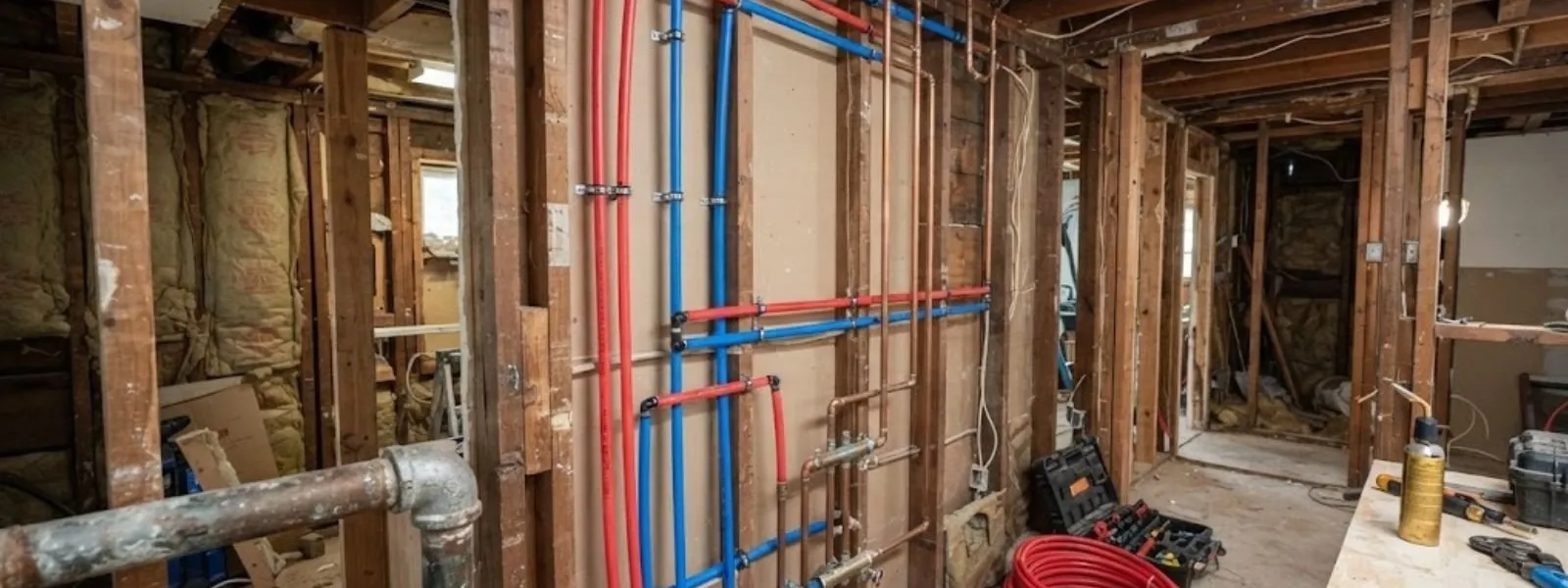
Repiping means replacing the water supply pipes inside a house, usually the whole system rather than one section at a time. In Newark, DE, most calls start with a symptom: water that runs brown, taps that sputter, or a third pinhole leak in a year. A licensed plumber can look at what is behind the walls and tell you whether a few repairs will hold or the system is at the end of its life.
Below: the warning signs, how galvanized and old copper behave, how new pipe materials compare, what the work does to your walls and where permits come in. Pipe material and condition vary house by house, so none of this is a diagnosis.
Signs your pipes may be failing
These clues often show up together.
- Discolored water: Brown or orange water that returns whenever a tap is opened after sitting can point to rust inside steel pipe. If it clears in seconds and affects every home on the street, nearby main work is a likelier cause.
- Falling pressure: Mineral buildup and rust narrow a steel pipe from inside, so flow drops at every fixture and gets worse over the years.
- Pinhole leaks: Tiny spray holes in copper, often more than one, show the pipe wall thinning from the inside.
- Repeat repairs: A leak fixed at one joint appears a few feet along. The pipe around it is likely just as worn.
- Stains or a metal taste: Rust marks on fixtures point to corrosion.
Water chemistry affects how fast pipe ages, and it varies by address. A home test kit shows what your tap delivers, and the City publishes an annual water quality report worth reading.
Galvanized and older copper pipe: what replacement involves
Galvanized steel is iron pipe coated in zinc. The coating wears away with time, and the pipe corrodes from the inside, so it narrows and sheds rust even when the outside looks fine. Replacement usually means taking the old pipe out completely instead of attaching new pipe to it, because the old connections limit flow and keep failing.
Older copper is a different story. It can last a very long time, but pinholes, failed solder joints and pitting show up in some houses. One leak does not mean the whole system has to go, though several in different places usually do.
Newark gives a few clues but not a verdict. The City's development plan says many neighborhoods around the Hillside Park pond, which drains Oaklands and Nottingham Green, were built in the 1950s and 60s, an age where pipe material is worth checking. Neither the plan nor any source we can cite says what pipe those homes have, so assume nothing. Have the plumber identify the material at your house.
If a lead service line or fitting is suspected, the City's Lead and Copper Rule page is the place to start, and the buried line to the street is covered in our guide to the pipe running from the street to your house.
PEX, copper or CPVC: choosing the new pipe
| Material | Strengths | Trade-offs |
|---|---|---|
| PEX | Flexible, so it snakes through walls with fewer cuts, and it handles freezing better than rigid pipe | Not for outdoor sun exposure, and fittings must be the right type |
| Copper | Long track record and fire resistant | Costs more in material and labor, and aggressive water can pit it |
| CPVC | Rigid plastic, resists corrosion, familiar to many plumbers | Can turn brittle with age and heat, and joints need careful solvent work |
There is no single winner. PEX is the most common choice for whole-house work because it is quick to install and tolerant of Delaware winters. Copper suits owners who want metal. Ask the plumber why they prefer a material.
Planning repiping?
Call to book a same-day appointment when one is available. You get a clear price before work starts.
What repiping does to your walls and your week
Repiping needs access, and access means openings. A plumber may cut small holes at floor and ceiling junctions, work through closets and basements, or open drywall along runs that cannot be reached otherwise.
- Walk-through and planThe plumber maps the runs and tells you where walls will open.
- Water shutdownThe house goes without water for part of each work day, so plan for cooking, washing and toilets.
- New lines roughed inNew supply is run to every fixture before old pipe comes out, and connections are made at the main and the water heater.
- Inspection and testWhere a permit applies, the rough-in is inspected before walls are closed, and the system is pressure tested.
- Patch and finishDrywall patching and paint may or may not be included, so ask before the work is scheduled.
Ask for the schedule in writing. Duration depends on house size, pipe count and access, and no honest estimate exists until the plumber has seen the walls.
Repair, partial repipe or the whole house
If one leak has a clear cause and the rest of the pipe looks sound, repair is the practical choice. A partial repipe, such as replacing one floor or one failing run, makes sense when the problem is limited. A whole-house repipe makes sense when failures are spread through the system or the pipe is a type known to fail.
The trade-off is cost and disruption now against repeated repairs later. If a hidden leak is part of the picture, tracing the leak first can show how widespread the damage is before you decide. New fixtures and added bathrooms are covered under plumbing installation.
Permits, licensing and lead
Delaware law reserves plumbing services for licensed master plumbers, and a limited homeowner exemption applies only to a person working on their own home, excludes gas piping, and requires a permit application. You can check a plumber's license at the state lookup.
Permit rules vary by location. A parcel whose County number begins with 18 answers to the City's Code Enforcement Division, and every other address, including homes in Brookside, answers to County Land Use. Newark's code treats swapping a concealed pipe for new material as new work needing a permit and inspection.
According to the City's permits page, the EPA's lead-safe renovation rule applies if your house was built before 1978, which means a company disturbing painted surfaces needs to be certified.
What affects the price of a repipe
Coverage depends on your own policy, so ask your agent before the work. Describe your house when you call, and the price you hear before work starts will be based on it.
Repiping FAQ
Not necessarily. Pipe material depends on the individual house, past remodels and previous repairs. The City of Newark describes some neighborhoods as built in the 1950s and 60s, but that does not tell you what is in your walls, so have a plumber identify it.
It depends on the size of the house, the number of fixtures and how easy the walls are to reach. Plumbers can give a realistic window after seeing the house, and you should ask for it in writing.
No. A partial repipe or a repair may be enough if the damage is limited. A plumber can show you where the pipe is worn and where it is still sound.
Galvanized pipe rarely fails all at once, but it corrodes and narrows with age. Persistent pressure loss or rusty water is a reason to plan replacement, and it is rarely an emergency by itself.
Often. Newark's code treats replacing a defective concealed water pipe as new work needing a permit and inspection, and the issuing office depends on your parcel. Even a homeowner using the state exemption has to file a permit application first.
Many people do, but water will be off for stretches each day and some rooms will be open. Ask how kitchens and bathrooms are handled.
Need a plumber instead of an answer?
Call (410) 378-7601