If you suspect a hidden leak in your Newark, DE home, your water meter can confirm it in about 15 minutes. Turn off every tap and appliance that uses water, then watch the meter. A dial that creeps forward, or a small leak indicator that keeps flickering, means water is escaping somewhere past the meter.
You do not need tools for this test, only a flashlight and a clear head. It will not tell you where the leak is, but it tells you whether you have one, and whether it is likely inside the house or in the pipe running to it. That alone saves a lot of guessing.
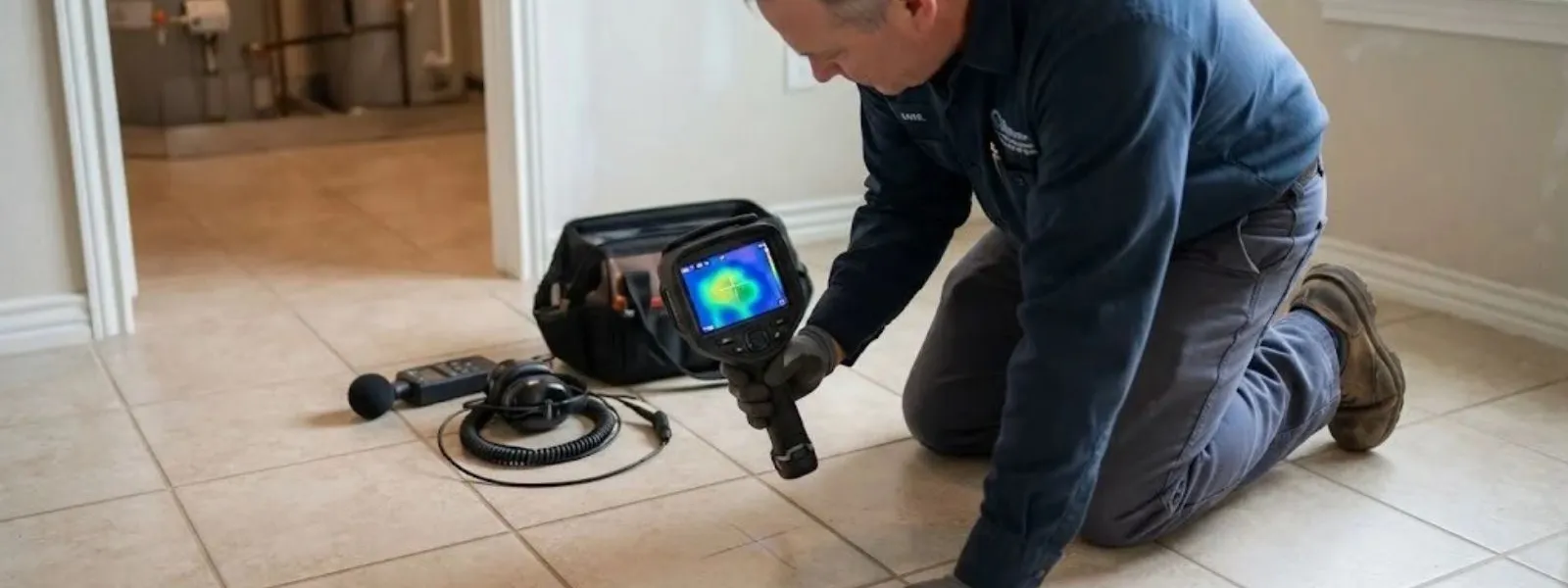
If the meter proves a leak and you cannot find the source, a plumber doing leak detection in Newark, DE can trace it with listening gear and pressure tests before anyone cuts into drywall or digs up a yard.
Run the meter test
Plan for a time when nobody is showering, running the dishwasher or washing clothes. Ice makers and automatic humidifiers also draw water, so switch those off or note them. The test works best when the house is quiet for the full quarter hour.
- Find the meter and clear the lidLook in the basement, utility room or a ground-level box, depending on how your home is plumbed. If you cannot find it, ask the City before you start digging around.
- Close every water useClose each faucet, pause the laundry and dishes, and ask everyone to hold off on flushing. Do not touch the main valve yet.
- Read the meter and write it downNote every digit on the register. Look for the small triangle, star or flow indicator, which spins or flickers when even a trickle passes through.
- Wait 15 minutes without using waterSet a timer. A longer wait, such as an hour, catches slow leaks better.
- Read it againCompare the numbers and watch the indicator. Any change at all means water moved while nothing was meant to be using it.
If the numbers moved, repeat the test once to rule out a neighbor flushing or a missed appliance. A second moving reading is a real signal.
How to read what you see
The result points you toward the right next step. The table below sorts the most common outcomes, and the third column is what a plumber would try first.
| What the meter does | Likely meaning | Sensible next step |
|---|---|---|
| Indicator spins steadily | Active leak, often sizable | Close the main inside the home and call for help |
| Indicator crawls or ticks now and then | Slow leak or a toilet seeping into the bowl | Do the toilet dye check, then book a trace |
| Reading moves only while a toilet is filling | Running toilet flapper | Repair the toilet before assuming a pipe leak |
| Nothing moves for an hour | No leak at that moment | Look at fixtures that leak only under use |
If the meter stops moving once you close the main shutoff inside your home, the leak is on the house side of that valve. If it keeps moving with that valve closed, the loss is between the meter and the valve, or the shutoff itself is not sealing. Either case is worth a professional look, and the second one often points to the supply line from the street.
Rule out the cheap culprits first
Toilets cause more phantom meter movement than buried pipes do. Add a few drops of food coloring to each tank and leave the bathroom alone for 15 minutes. If color appears in the bowl without a flush, the flapper is leaking, and a toilet repair usually fixes the problem in one visit.
Check under every sink and behind the washer for damp cabinet floors, swollen trim or a musty smell. Look at the water heater's relief valve discharge pipe for drips, and walk the yard looking for soft, unusually green or squishy ground between the house and the street. A water heater that weeps from its tank is a separate fix, covered by water heater repair.
Planning this repair?
Call to book a same-day appointment when one is available. You get a clear price before work starts.
What Newark residents should know before testing
If you need the street-side valve closed while a repair is scheduled, the City can shut the water off at the curb once the repair is booked. Your own interior main shutoff is the faster option in a real emergency, so make sure you know where it is before you need it.
When a meter test points to the yard or the slab
A leak between the street and the house shows up as a moving meter with every fixture off and sometimes a wet patch, a sinking spot in the lawn or a dip in pressure. Slab leaks add warm floor patches or a faint hiss at night. Neither is a do-it-yourself repair, because the pipe is buried or under concrete and a wrong dig can hit gas, electric or other lines.
Delaware's one-call system, reached through call811.com, handles marking underground utilities before any digging. A plumber handling a buried supply line will often need that done first, and sometimes a permit as well. For a failing pipe between the street and your home, the next page to read is water service line repair.
The same test works in nearby towns, but the office you call about meter questions may differ. Brookside is a separate community next to Newark, not part of the City, so ask your own water provider there. If you live just outside the city line, see what we handle in Glasgow or Brookside.
What to do while you wait for a plumber
- Close the main shutoff inside the house if the meter spins with everything off.
- Move rugs, boxes and electronics off any wet floor or wall, and keep power cords out of standing water.
- Take a photo of the meter reading and the time, because it helps whoever traces the leak.
- Do not run the dishwasher or washer while you wait, since both add noise to the test.
- Write down where you saw damp, stains or soft ground, even if you are not sure it matters.
Frequently asked questions
It is very good at detecting that water is moving, but it cannot say how much you are losing or where. A dripping fixture and a pinhole in a buried pipe can both show as a slow-moving indicator. Waiting an hour instead of 15 minutes makes slow leaks easier to catch.
Start by running the toilet dye check and closing the interior main to see which side of the house the loss is on. The City says it notifies customers about suspected leaks and will help identify the source on request, so ask Public Works and Water Resources whether your account was flagged. If you cannot find the source yourself, book a licensed plumber for a trace.
There is no published adjustment policy we can point you to, so we cannot promise one. Ask the City's billing office directly, and keep a record of your meter readings, the date you found the problem and the repair invoice. Those records are what any office will ask for.
A slow leak still wastes water and can soften framing, flooring and drywall, and it can grow without warning. If the leak is inside a wall or under the floor, treat it as urgent. Our dispatch runs 24/7, so an after-hours call is an option when the main valve is not holding or water is reaching electrical areas.
Delaware law requires plumbing services to be done by a licensed master plumber. The one exception is a homeowner working on their own non-rental home, and that still involves a permit application. Before you hire anyone, look them up in the state's online license verification tool at delpros.delaware.gov.
Need a plumber instead of an answer?
Call (410) 378-7601