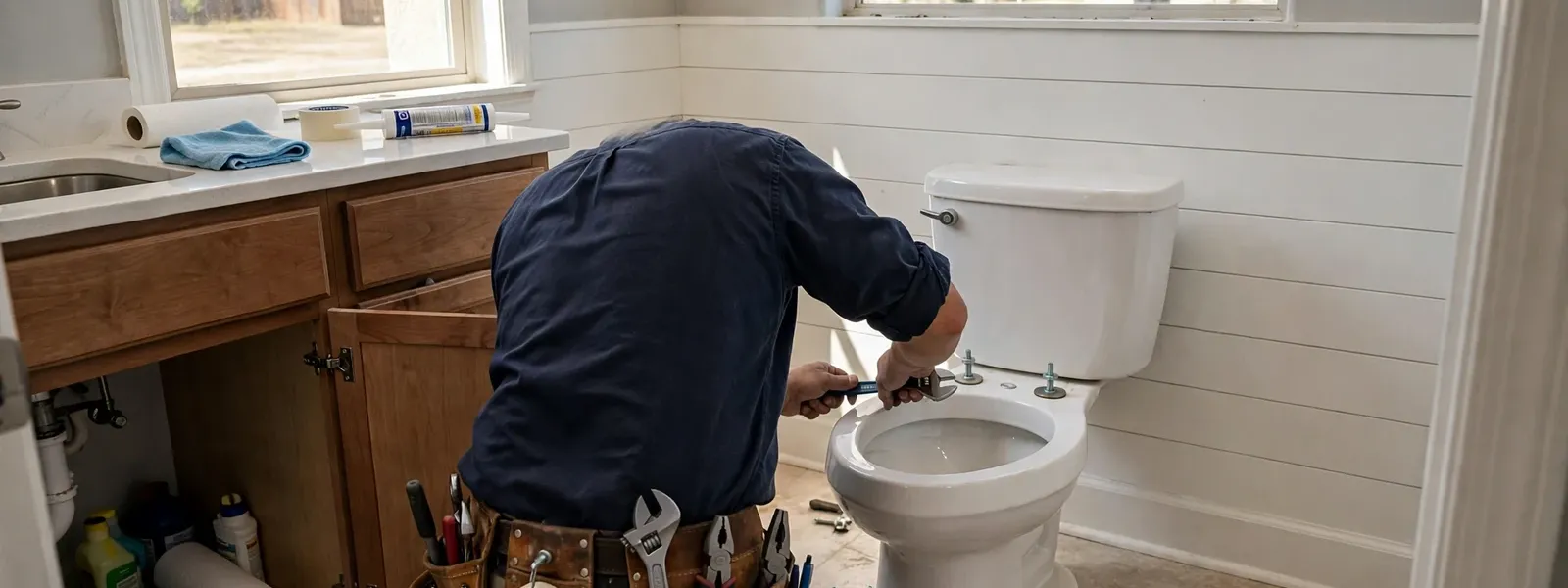
Replacing a toilet shut-off valve in a Newark, DE home is a short job for a plumber when the valve and the pipe behind it are in good shape. It is a small job with a big failure mode, since cutting into old pipe or a corroded stub can turn a drip into a flood. If the valve has not been turned in years, call a licensed plumber rather than forcing it.
The shut-off valve, often called a stop or angle stop, is the small oval or round-handled fitting on the wall or floor behind the toilet. It lets you stop water to one fixture without shutting off the whole house. A bad one drips at the stem, weeps at the nut, or refuses to close, and each of those is a reason to replace it.
This page covers how to tell what you have, how the swap goes, what the Delaware rules say about doing it yourself, and the signs that it is a plumber's job.
Which valve you have
Multi-turn compression stop
The common one. A round handle turns several times, and a rubber washer inside seals the flow. It wears and sticks after years of never being used.
Quarter-turn ball stop
A lever turns 90 degrees from open to closed. It lasts longer, seals better and shows its position at a glance.
Sweat or soldered connection
The valve is soldered onto a copper pipe. Replacing it means cutting the pipe or using a different connection method.
Push-fit or compression to the pipe
Slides or tightens onto the pipe without heat. It suits many repairs but needs a clean, round pipe end.
Old galvanized or chrome-plated brass stop
Often sealed by decades of mineral scale, and the handle can break or leak when turned.
Check the supply line too. A braided stainless line that connects the valve to the toilet tank is usually replaced at the same time, since a new valve with an old line leaves a weak point.
DIY or plumber: a decision table
| Your situation | DIY looks reasonable | Call a plumber |
|---|---|---|
| Valve drips at the handle only | Sometimes, if the main can be shut | If the valve will not turn |
| Valve will not close at all | Rarely | Yes, the main must be shut first |
| Pipe behind the valve is soft, corroded or galvanized | No | Yes |
| Old house with unknown pipe | No | Yes |
| Rented house or apartment | Not allowed under the owner exemption | Yes, through the landlord |
| Water already leaking at the wall | No | Yes, shut the main and call |
The right column is longer than you might expect. That is because the risk sits behind the wall, where you cannot see it. The stop valve is cheap, the repair behind it is not.
The swap, step by step
- Shut the waterClose the main shutoff, then flush the toilet and open a faucet to drain the lines. If the main does not close, stop here.
- Remove the supply lineHold the valve with a wrench so the pipe does not twist, and unscrew the nut under the tank. Catch drips in a towel and a small bowl.
- Remove the old valveCompression valves unscrew with a wrench, and the old ferrule may need to be cut off. Soldered valves require cutting the pipe or heating the joint.
- Prepare the pipeThe pipe end must be clean, round and free of scale. A pipe that is out of round cannot seal a compression fitting.
- Fit the new valveSlide on the nut and ferrule, seat the valve and tighten. Do not overtighten, since that deforms the ferrule and causes the leak you were trying to fix.
- Reconnect and testAttach a new supply line, open the main slowly, open the new valve and check for drips after ten minutes and again later.
Planning this repair?
Call to book a same-day appointment when one is available. You get a clear price before work starts.
What goes wrong, and what that costs you
The usual failure is a stuck valve that finally cracks when someone tries to close it in a hurry. The second is overtightening a nut, which makes a slow weep that rots the cabinet or floor underneath. The third is a pipe that gives way when the valve is removed, which turns a small job into a repiping question that our repiping page covers.
Valves should be exercised once or twice a year. Turn each one fully closed and fully open, which keeps scale from locking the stem.
Delaware rules and who closes the street valve
Brookside and other addresses outside the city fall under county rules. If you live in Brookside or Glasgow, the same exemption logic holds, and the permit office is New Castle County.
When it is really a leak problem
A damp wall, a stain on the ceiling below, or a water bill that jumped may mean the valve is not the only leak. Our leak detection service looks at that. The toilet repair page covers a running toilet, a wobbly bowl and a clog.
Questions about shut-off valves in Newark, DE
Under Title 24, Chapter 18, an owner may do non-gas plumbing in their own home if the home is not for sale or rented, and a permit application is filed. The Division of Public Health says a permit must be obtained. Ask Newark's code office or New Castle County whether a valve swap needs one at your address.
Stop forcing it. A stuck stop usually has scale in the stem, and pushing harder can crack it. Shut the whole-house main, and if the main fails too, a plumber can arrange a street shutoff through the City.
The City's water department does it at the curb once the repair is booked. The City's FAQ describes the City doing the shutoff, so ask the department before you reach into the curb box yourself.
Yes, in most cases. A new valve on a decades-old line leaves the weakest part in place. A braided stainless supply is inexpensive next to a flood.
A slow drip is not, but a spray or a valve that will not close is. Shut the main and book a plumber, because dispatch runs 24/7.
Need a plumber instead of an answer?
Call (410) 378-7601