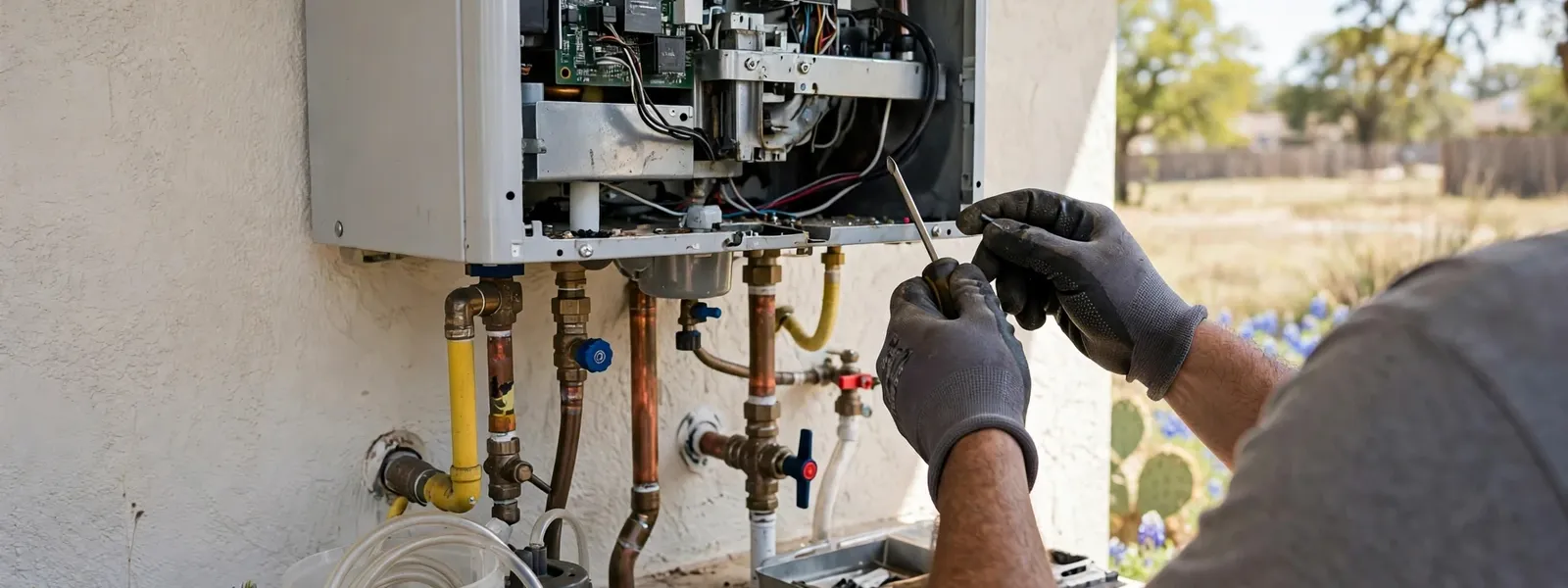
Installing a tankless water heater in Newark, DE is not a bolt-on swap for a tank. The new unit needs a gas line or electric circuit that can feed it, a vent that matches its type, a drain for condensate, and service valves for flushing. Gas piping work has to be done by a licensed professional under Delaware law, and a rebate claim has to be set up before the work starts.
So a good installation starts with a survey, not a purchase. This page lists what the plumber looks at, what usually has to change, what the install day involves, and the points that trip up local homeowners.
The general case for and against tankless is on our tankless water heater service page. Here the focus is the install itself.
The survey: seven things a plumber checks first
- Fuel today: natural gas, propane or electric, and how the current heater is vented.
- Gas meter and line size, or electrical panel capacity and open breaker spaces.
- Where the unit can mount, and whether the wall can carry it and the vent path.
- How many fixtures run at once, such as two showers and a dishwasher.
- Incoming water temperature in winter, which sets how much the unit has to heat.
- Whether a floor drain or a condensate route is nearby.
- Age and material of the existing hot and cold piping at the heater.
Winter matters more than most people expect. NOAA's 1991-2020 normals for the University of Delaware farm station put January's average low near 25 degrees Fahrenheit. Cold ground and cold air mean cold incoming water, so a unit has to work harder to deliver the same shower, and a vent or condensate line that runs through an unheated space can freeze. Say so during the survey.
Gas or electric: what each demands
| Question | Gas or propane unit | Electric unit |
|---|---|---|
| What must be upgraded | Gas line size, regulator or meter capacity | Panel capacity and dedicated heavy circuits |
| Venting | Required, with type set by the model | Usually none |
| Condensate | Condensing models need a drain | None |
| Who may do the work | Licensed plumber for gas piping | Qualified electrician for wiring, plumber for water |
| Typical surprise | Existing gas line too small for the load | Panel has no room |
A gas tankless unit pulls much more fuel at full burn than a tank heater does, so the existing line often is not big enough. That is why a plumber adds up every gas appliance in the house, not only the new heater.
The county's gas piping permit rules want plans that list each appliance's BTU load. Those guidelines are written for county jurisdiction and may not apply inside the city line, so ask the office that covers your parcel.
Venting and condensate
Gas tankless units need venting suited to the model. High-efficiency condensing units vent through plastic pipe and produce acidic condensate that has to drain away, often through a neutralizer. Non-condensing units run hotter and need a vent material built for it.
The old tank's flue cannot always be reused. Existing chimney liners are often sized for a larger flow of hotter exhaust, and the county's replacement checklist includes a line confirming an existing chimney is cleaned and sized properly. Plan on the vent being redone and priced as part of the job.
Hard water, service valves and the unit's life
The Department of Energy puts tankless life at about 20 years, roughly 5 to 10 years longer than a typical tank. That figure depends on scale control. No hardness figure is quoted here because it differs from one Newark address to the next. A test kit on your own tap gives a number, and the City's water department publishes a yearly quality report worth reading.
Ask for isolation valves with flush ports on the water lines. They let a plumber circulate a descaling solution through the heat exchanger later, and without them flushing is a hassle. A water softener upstream is worth discussing if your test shows hard water.
Planning this repair?
Call to book a same-day appointment when one is available. You get a clear price before work starts.
Install day, in order
- Shut off and remove the old heaterWater, fuel and power go off, the tank drains and the old unit comes out with its flue.
- Mount the new unitIt goes on a wall bracket at a code-approved height and clearance, away from combustibles and in line with the vent route.
- Pipe the water sideHot and cold lines connect, with service valves, a pressure relief valve and a way to flush.
- Fuel or powerA gas unit gets its new or resized gas line and a leak test. An electric unit gets its dedicated circuit.
- Vent and drainThe vent runs to the outside termination and the condensate line to a drain.
- Fire up and testThe plumber checks flow, temperature rise, combustion and every joint, and sets the temperature.
Rebate steps that must come before the work
What a homeowner may and may not do
Delaware lets owners handle non-gas plumbing at their own residence, as long as the house is not for sale or rented out and the permit paperwork has been filed. The gas line for a tankless unit falls outside that exemption. Even for the water side, a permit is part of the picture, and the Title 24 text is public.
A licensed plumber is the safe route for the whole job. For a quote, the plumber needs your fuel, panel or meter details, and photos of the current heater. We also serve Brookside and Glasgow, where the permit office differs from the city's.
If you smell gas: when to evacuate and call
A gas smell means getting everyone outside, calling the gas utility and 911 from there, and only afterward calling a plumber. A gas tankless unit that smells wrong or trips its safety lockout needs water heater repair service from a licensed professional, not a DIY fix.
- Leave the building with everyone in it before you do anything else.
- Do not flip switches, light a flame or use a landline or cell phone indoors.
- Phone the utility and 911 once you are outdoors, then reach a plumber.
- Stay out until the utility says the house is clear.
Questions about tankless installation in Newark, DE
No. Delaware's homeowner exemption covers plumbing services other than gas piping, so gas work needs a licensed professional. New Castle County's gas piping permit also asks for plans with the BTU load of each appliance. Ask the office for your parcel what it requires.
Probably, and the office depends on your parcel. A parcel number starting with 18 means asking Newark's code office, and anything else is handled by the county's land use office. Permit rules vary, so confirm before the work begins.
Often not. Tankless exhaust differs from a tank's, and condensing models use plastic vent pipe and a condensate drain. The plumber measures the old flue and tells you whether it can be reused.
Test your tap, because hardness differs by address. If the result is high, scale builds on the heat exchanger, and flush valves plus periodic descaling protect the unit.
Yes, for gas or propane units that are rated 90 UEF or higher, and only through a participating contractor. The assessment and reservation come first, and amounts change, so confirm the current terms.
Need a plumber instead of an answer?
Call (410) 378-7601