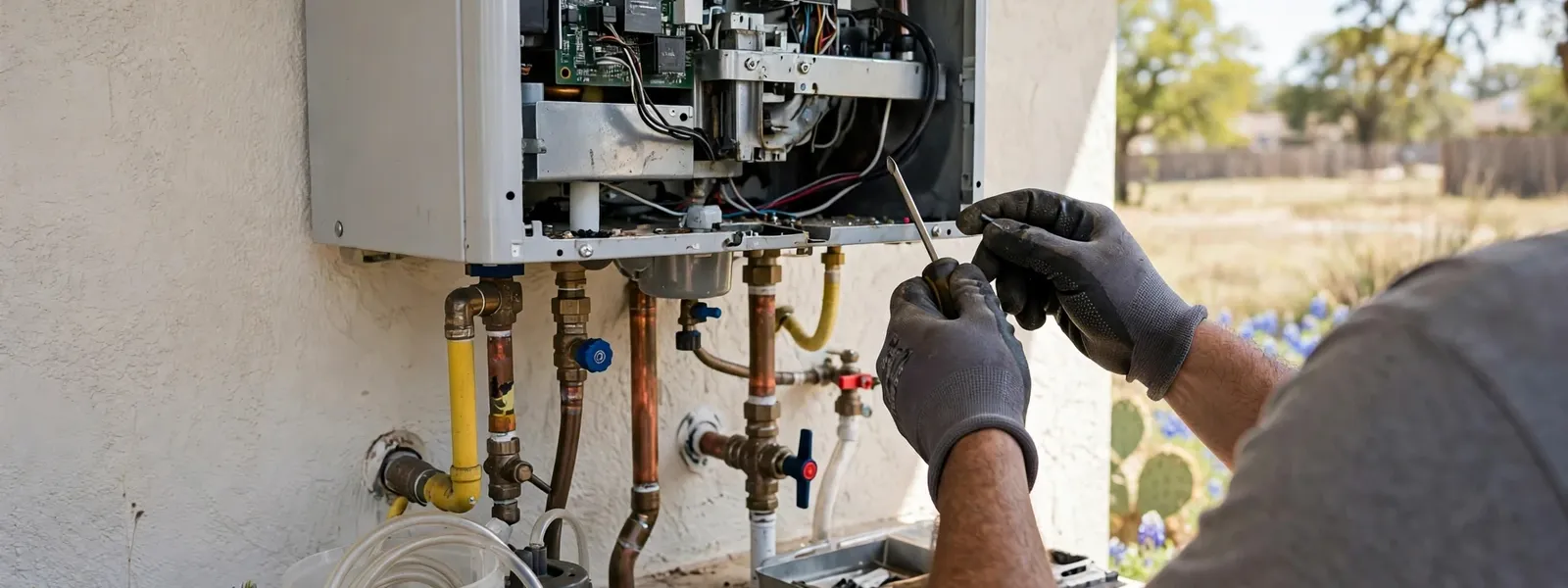
A leaking tankless water heater in a Newark, DE home is not like a leaking tank. Many tankless leaks start at a loose or worn connection, a valve, or the condensate drain, and those are fixable. A leak from inside the cabinet, from the heat exchanger, usually means the unit is done. Shut the water to the heater, switch off its power, and then work out where the water is coming from.
On a gas unit, any gas smell changes the plan: get everyone outside, contact the gas utility and 911 from a safe distance, and call a plumber last. Nobody should be working on a gas appliance while that smell is in the air.
A tankless heater has no big tank to flood your floor, so a leak can look small for weeks before it does damage. That slow pace is why it gets ignored, and why this page is about reading the clues early.
Do these first
- Cut power and fuelSwitch the unit off at its power switch or breaker, but only from a dry position. For a gas model with no gas smell, close the gas valve at the unit.
- Close the waterShut the cold supply isolation valve at the heater, and the hot valve if it has one. If those valves will not move, close the home's main shutoff.
- Catch and photographPut a towel or pan under the drip, and photograph the unit, its label and any error code on the display.
- Dry the areaWipe the cabinet and the fittings dry, then check again in an hour to see where fresh water appears first.
- Call a plumberA licensed plumber should handle a leaking gas appliance, and they will want the photos.
Those first moves give the plumber a clean starting point, and they stop a small leak from running while you wait.
Where the water is coming from
| Where it leaks | Usual cause | Fixable? |
|---|---|---|
| Water pipe connections or unions | Loose nut, worn washer, mineral scale | Often, with new washers or fittings |
| Isolation or service valves | Worn valve stem or a cracked fitting | Yes, valves are replaceable |
| Pressure relief valve discharge | Excess pressure or a worn valve seat | Yes, but find why pressure rose |
| Condensate drain or neutralizer | Blocked trap, cracked tubing, full neutralizer | Yes, clean or replace the parts |
| Inside the cabinet, from the unit | Cracked heat exchanger or failed internal seal | Rarely worth the part |
| Cabinet corrosion or frozen damage | Freeze split or long-term seepage | Usually replace the unit |
A relief valve that drips is a warning, not a nuisance. Do not cap it. The valve is there because the system is seeing pressure or temperature it should not.
The leaks people mistake
Condensing gas units make acidic condensate as a normal byproduct. It runs out through a drain line, often into a neutralizer. If that line is blocked or kinked, water backs up and appears at the bottom of the unit. This looks alarming, but a plumber can often clear it.
Another common mistake is blaming the heater for a leak in a nearby pipe. Water can travel along a joist or a pipe before it drips, so the real source may be a fitting above. If the unit stays dry once you wipe it, look at the lines overhead. Our leak detection service covers tracing water that shows up far from its source.
What the plumber checks on the visit
Expect a methodical look rather than a quick swap. The plumber dries the unit, runs it, and watches where the first bead of water forms. They check the display for fault codes, test the water pressure, look at the condensate path, and press on each union and valve for movement.
If the leak is at a fitting, the fix is often new washers or a replacement valve on the spot. If water appears from inside the casing, the plumber will say so plainly and explain the replacement options, since a heat exchanger is rarely worth a repair.
Planning this repair?
Call to book a same-day appointment when one is available. You get a clear price before work starts.
Hard water and scale
Scale builds up on the heat exchanger and valves and can stress seals. How hard Newark's water is varies by address, so test your tap and read the City of Newark's annual water quality report. A unit that has never been descaled in hard water ages faster, and a flush with isolation valves slows that.
When to call a plumber right away
- The unit smells of gas. Everyone goes outside first, and the utility and 911 get the call.
- Water is reaching the unit's electrical panel or display. Keep clear and cut power only from a dry position.
- The pressure relief valve is spraying hot water or steam. Stay away from the discharge, because it can scald.
- The leak keeps going after the unit's water valves are closed. Shut the home's main shutoff.
Repair or replace
The US Department of Energy gives tankless units about 20 years of life, so a leak in a young unit is a repair question and in an old one is a replacement question. A leaking connection or valve is a small repair on a unit of any age. A cracked heat exchanger on a unit near the end of its life usually points to a new one.
Ask whether the unit is still under the maker's coverage before authorizing anything. The label photo gives the model and serial number the plumber needs to check that.
The tankless water heater service page covers repair and descaling. If the unit has failed for good, our water heater replacement page explains the decision.
Local rules that apply to a failed unit
Addresses in Bear and Glasgow fall under county jurisdiction for permits, while parcels starting with 18 go through Newark. Calls are answered around the clock, and an open same-day slot can be booked.
Questions about leaking tankless heaters in Newark, DE
Call a plumber. The City handles the water main and the curb shutoff, not equipment inside your home. Phone the City only if you need the street valve closed because your own main will not turn.
Delaware lets an owner do certain non-gas plumbing at a home that is neither for sale nor rented, once the permit paperwork is filed. Anything touching gas piping is outside that. For a leaking gas appliance, a licensed plumber is the safer choice.
It can be, since it opens when pressure or temperature climbs past a safe point or when its seat has worn. Turn the unit off and have a plumber test the system before it runs again.
Yes, in a cold snap. January lows near the University of Delaware farm station average around 25 degrees Fahrenheit, and a condensate line or exterior vent in an unheated space can freeze. A freeze split in the unit itself usually ends the heater's life.
Many homeowners policies respond to a sudden burst and not to a slow seep that went on for months, so read your own policy. Fixing a small drip early also keeps a claim question from arising at all.
Need a plumber instead of an answer?
Call (410) 378-7601